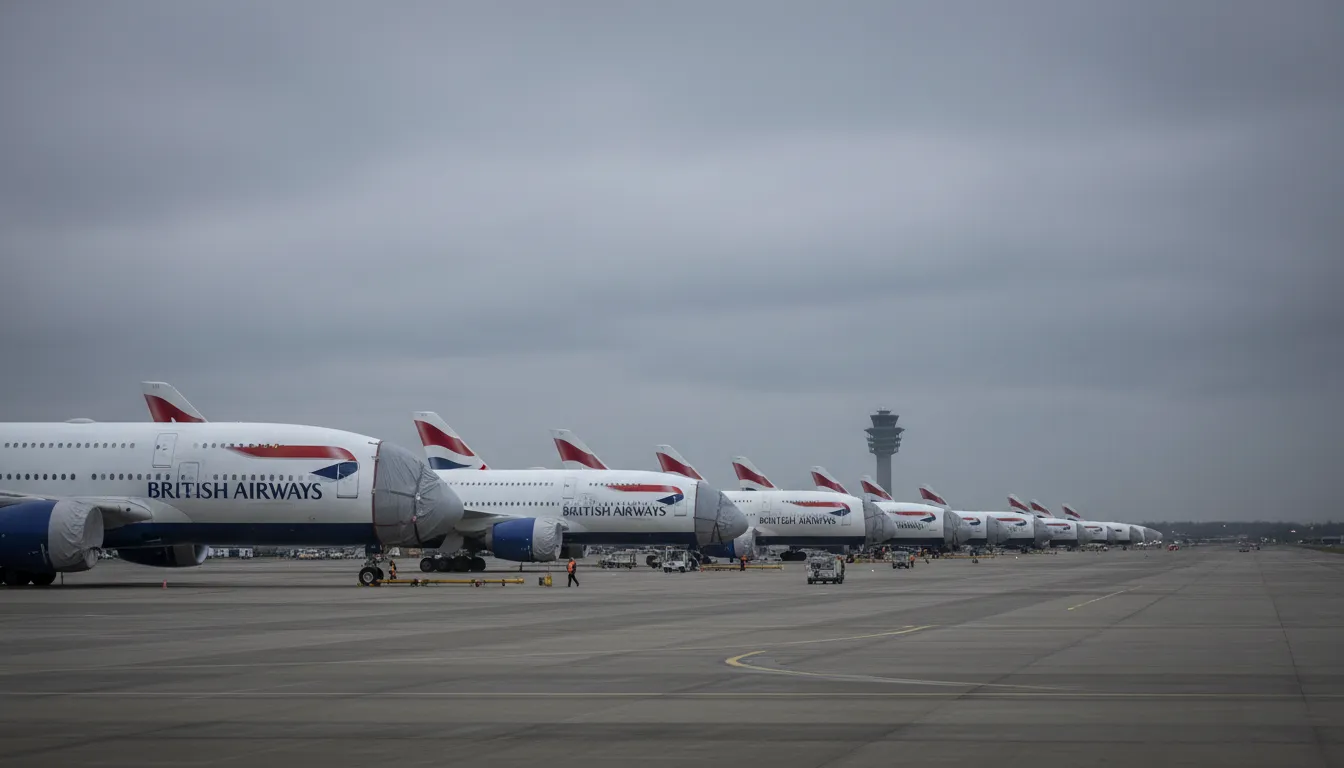
British airlines are sitting on five to six weeks of jet fuel reserves—a buffer that, while not immediately alarming, is rapidly becoming a countdown clock as the U.S.-Iran conflict keeps the Strait of Hormuz effectively closed to normal tanker traffic. Industry sources and airline executives have begun warning that if supply conditions do not normalize by early May, carriers will face difficult choices between grounding aircraft, slashing schedules, and absorbing fuel costs that have nearly doubled in the past month alone.
The situation is already acute elsewhere. Asian carriers, which depend far more heavily on Persian Gulf supply chains than their European counterparts, have moved from contingency planning to active service cuts. The crisis has arrived fastest and hardest in Asia—and British airlines are watching closely, aware that what is happening in Seoul and Hanoi today could reach London by May.
Asia Moves First as Supply Chains Snap
Vietnam Airlines has suspended seven domestic routes indefinitely and cut international flight frequencies, citing the inability to guarantee consistent jet fuel supply at the prices and volumes required to operate normally. Korean Air activated its emergency management protocols earlier this week, a formal escalation that puts the carrier on crisis footing and authorizes route suspensions without the usual advance notice to passengers. Lufthansa, while not yet cutting routes, confirmed it has prepared contingency plans to ground a portion of its fleet should demand collapse suddenly or fuel availability tighten further.
The disparity between Asian and European exposure reflects geography and supply chain structure. Asian refineries sourcing crude from the Persian Gulf have been disrupted most directly by the Strait of Hormuz closure, which previously handled more than a quarter of all globally traded seaborne oil. European refineries, including those supplying the major U.K. airports at Heathrow, Gatwick, and Manchester, draw from a more geographically diverse set of suppliers—North Sea crude, West African grades, and North American imports all feature in the mix—giving British carriers a modest but finite additional runway before the supply crunch reaches them.
Ryanair Warns of May Supply Risk
Ryanair chief executive Michael O'Leary, never one to understate a commercial threat, issued a blunt assessment of the situation facing European carriers.
"There is a risk of supply disruptions in Europe beginning May 1 unless oil and gas trade normalizes. Maybe 10 per cent to 25 per cent of our supplies might be at risk through May and June." — Michael O'Leary, CEO, Ryanair
The range O'Leary cited—10% to 25%—is significant. A 10% shortfall is manageable through schedule optimization, demand-side pricing adjustments, and drawing down available reserves. A 25% shortfall at the peak of European summer travel season would force meaningful capacity reductions at one of the continent's highest-volume carriers, with knock-on effects throughout the low-cost aviation sector and on the holiday travel plans of millions of passengers.
Ryanair has hedged approximately 80% of its annual fuel requirements at pre-conflict prices—a position that cushions the immediate financial impact of the price spike but does nothing to address the physical availability question if refineries cannot source sufficient crude to produce jet fuel in adequate volumes.
IAG and the Five-to-Six-Week Window
British Airways parent company IAG occupies a somewhat more insulated position than Ryanair on both the financial and supply sides of the equation. Sources familiar with the group's operational planning indicate IAG holds five to six weeks of operational runway before shortages would begin to impact scheduled service, and executives have stated publicly that there are "no concerns right now" about near-term fuel availability.
IAG has hedged between 60% and 70% of its annual fuel requirements at pre-crisis prices, limiting the group's immediate cash exposure even as spot jet fuel rates have surged. However, the hedging contracts that protect airlines financially do not guarantee physical supply. If refineries cannot acquire sufficient crude to manufacture jet fuel, the financial protection of a hedge becomes irrelevant to the operational question of whether aircraft can depart.
The five-to-six-week reserve figure, while reassuring in the immediate term, sets a clear deadline. If the Strait of Hormuz remains disrupted into mid-May without meaningful alternative supply routes compensating for lost volumes, even the most hedged and well-prepared British carriers will face operational pressure.
Jet Fuel Prices Have Nearly Doubled
The financial dimension of the crisis has intensified rapidly. Jet fuel prices have risen nearly twice as fast as crude oil over the past month, a dynamic driven by the tightening of global refinery output as crude input volumes fall and refiners compete for available supply. Where crude oil benchmarks have surged approximately 50% month-over-month, jet fuel spot prices have roughly doubled—a spread that reflects the additional downstream tightness in refined product markets.
For airlines operating without hedging protection, the economics of every flight have changed dramatically. Even for hedged carriers, the portions of fuel purchased at spot rates or with hedges approaching expiry represent a materially higher cost base than was the case 30 days ago. Emergency fuel surcharges have already appeared on transatlantic and long-haul routes operated by multiple carriers, and analysts expect further surcharge filings if conditions persist.
"Airlines UK can confirm that carriers continue to engage with fuel suppliers and government to monitor the situation closely." — Airlines UK spokesperson
The measured language from the industry body stands in contrast to the operational urgency playing out at Asian carriers. Britain's aviation sector is not yet in crisis, but the coordination between airlines, suppliers, and government that the statement describes points to an industry that understands the clock is running.
The Strait of Hormuz Factor
The root cause of the aviation fuel crunch is the disruption to tanker traffic through the Strait of Hormuz, a 33-kilometre-wide chokepoint at the entrance to the Persian Gulf through which approximately 20% of the world's seaborne crude oil ordinarily passes. Iran's territory flanks the strait on its northern shore, and the ongoing U.S.-Iran conflict has rendered normal transit effectively untenable for commercial tanker operators. Insurance underwriters have imposed war-risk surcharges that make Gulf transits prohibitively expensive for most vessels, and major shipping operators have voluntarily rerouted cargoes around the Cape of Good Hope—adding 10 to 14 days to journey times and sharply increasing shipping costs.
The longer route via the Cape means that supply disrupted today does not fully translate into refinery shortfalls for another two to three weeks—which is precisely why British carriers still report adequate near-term supply even as the upstream situation has deteriorated sharply. But it also means the crunch that Asian carriers are experiencing now is, in effect, a preview of what arrives in European markets within the coming weeks if the conflict does not abate.
What Comes Next
The variables that will determine whether Britain's airlines navigate this crisis with manageable disruption or face genuine capacity cuts are largely geopolitical. A ceasefire or negotiated reopening of the Strait of Hormuz would allow tanker traffic to resume, refinery inputs to normalize, and the jet fuel market to begin rebalancing—though the price effects would linger for weeks as inventories rebuild. Absent that, the five-to-six-week reserve buffer now held by carriers like IAG represents the effective horizon of current certainty.
Strategic petroleum reserve releases coordinated through the International Energy Agency can provide some cushion, but the IEA's 60-million-barrel release announced earlier this week is widely viewed as insufficient to fully replace lost Gulf supply over a sustained conflict. Alternative crude supply from North Sea producers, West African exporters, and North American shippers can partially compensate, but not at the speed or volume required to seamlessly replace Persian Gulf flows in Asian markets.
For British passengers planning summer travel, the near-term picture remains intact. For airline operations directors watching reserve levels and monitoring tanker tracking data, the window for a benign resolution is measurable in weeks, not months.