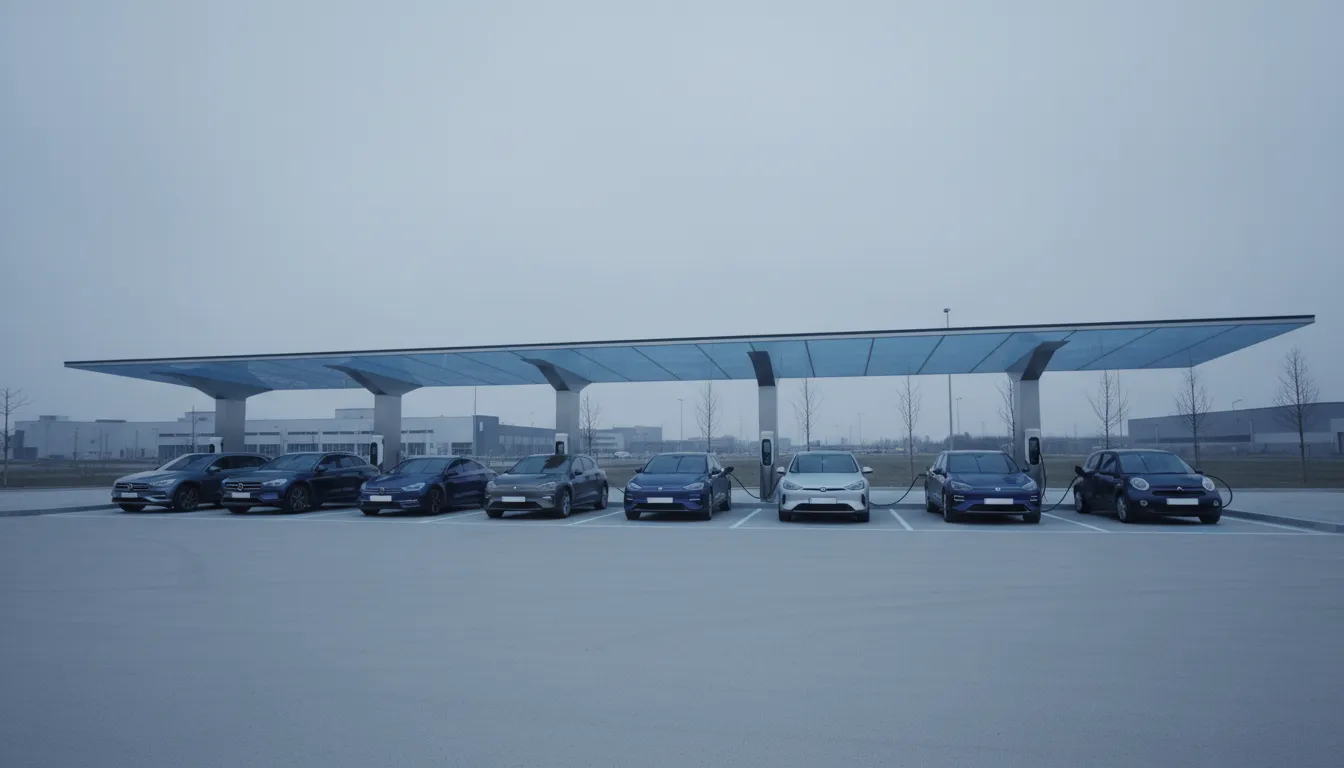
Tesla reported a disappointing first quarter on Wednesday, delivering 358,023 vehicles worldwide and falling short of Wall Street's consensus estimate of roughly 372,000. The miss marks the electric-vehicle maker's second consecutive quarter below analyst forecasts, signalling that the road to displacing combustion-engine demand may be considerably bumpier than energy markets had priced in only a year ago.
The Numbers Behind the Miss
Tesla produced 362,615 vehicles during the January-to-March period while delivering 358,023 — a gap of roughly 4,500 units that reflects both logistics bottlenecks and sluggish retail traffic in key markets. Year-over-year deliveries rose 6.3%, a positive headline that nevertheless failed to satisfy investors conditioned to Tesla's historically aggressive growth trajectory. Shares fell sharply in pre-market trading as the report circulated.
The Model 3 and Model Y combination, which forms the backbone of Tesla's volume, bore the brunt of the shortfall. Deliveries of those two models came in at approximately 335,000 units — well below the roughly 348,000 that analysts had modelled. The higher-priced Cybertruck and Model S/X lines contributed the remainder, though those segments remain too small to move the aggregate needle in any meaningful way.
"Two consecutive quarters of delivery misses is not a blip — it is a trend. Tesla is navigating a structural deceleration in EV adoption that the wider market underestimated." — Senior Automotive Analyst, Bloomberg Intelligence
Slowing EV Demand: A Structural Shift, Not a Blip
The EV sector's growth story has become increasingly complicated over the past eighteen months. After a period of explosive adoption driven by government subsidies, pent-up demand, and the novelty factor, EV sales growth has moderated materially across every major market. In the United States, federal tax credit eligibility has tightened under revised Treasury guidance, squeezing affordability for a broader swath of buyers. In Europe, Germany's abrupt end to its EV subsidy program in late 2023 created a demand hangover that still lingers in the region's registration data. China, which accounts for more than half of global EV sales, has seen brutal margin compression as dozens of domestic manufacturers compete aggressively on price — a dynamic that has pressured Tesla's China volumes and profitability simultaneously.
Charging infrastructure, while expanding, continues to be cited in consumer surveys as the primary barrier to EV adoption among households that lack dedicated home charging. Range anxiety has not disappeared; it has simply been displaced to anxiety about charging time and reliability on long-distance routes. These friction points collectively push the EV adoption curve lower in the near term, keeping combustion-engine vehicles — and the fuel they burn — relevant for longer than the most bullish energy-transition forecasts assumed.
What Tesla's Miss Means for Oil Demand
The link between EV adoption and oil consumption is direct: every battery-electric vehicle displaces some quantity of gasoline or diesel demand over its lifetime. The International Energy Agency (IEA) has estimated that the global EV fleet displaced roughly 1.5 million barrels per day (mb/d) of oil demand in 2024. That figure is projected to reach 6 mb/d by 2030 under its Announced Pledges Scenario — a trajectory that depends on EV sales continuing to grow at double-digit annual rates.
When the world's most high-profile EV company misses delivery targets for two quarters running, it raises legitimate questions about whether the demand-displacement curve is tracking the IEA's optimistic path. Slower EV penetration means slower erosion of liquid fuel consumption, which in turn provides a floor under oil demand that traders cannot ignore. Brent crude has been sensitive to EV adoption news in recent quarters, with bullish surprises in combustion-engine vehicle sales tending to firm prices at the margin.
OPEC+ has been watching the EV adoption data carefully. The group's internal modelling has consistently projected a more gradual demand decline than Western agencies, and Tesla's consecutive misses lend empirical support to that view. If the EV ramp continues to disappoint, OPEC+ may feel less pressure to accelerate planned production increases — a supply management posture that would support prices across the forward curve.
Competitive Pressure and the China Factor
Tesla is not struggling in a vacuum. The competitive landscape for EVs has transformed dramatically since 2022. Chinese manufacturers — led by BYD, but also including SAIC, Geely's Zeekr brand, Li Auto, and NIO — have brought well-specced, aggressively priced vehicles to market at a pace that has challenged Tesla's product cadence. BYD overtook Tesla as the world's top-selling EV maker in 2023 and has continued to expand its lead.
In Europe, Volkswagen's ID. series, Stellantis's Jeep and Peugeot EV lines, and a wave of Chinese imports have filled showrooms with options that compete directly with the Model 3 and Model Y on price. The result is a more fragmented EV market where no single manufacturer can credibly serve as a proxy for the entire sector — which itself complicates any top-down demand forecast derived from Tesla's sales data alone.
Nevertheless, Tesla's scale and brand recognition mean its delivery numbers remain the most closely watched single data point in the global EV space. When Tesla stumbles, the narrative around EV adoption stumbles with it, regardless of what BYD or Volkswagen may report in the same period.
Market Impact
Energy markets absorbed the Tesla news with cautious calm, but the underlying implications for the demand outlook are real. Oil traders noted that the delivery miss, combined with a broader softening in global manufacturing PMIs, tilted the near-term demand picture slightly toward the bearish side.
- Brent Crude: Edged modestly higher on the session as the slower-than-expected EV ramp reinforced the view that liquid fuel demand will remain resilient through the late 2020s.
- WTI: Tracked Brent with a slight discount, supported by healthy US driving-season demand expectations and a drawdown in Cushing inventories reported earlier in the week.
- Natural Gas: The EV miss has little direct bearing on gas markets, though slower electrification of the vehicle fleet could modestly reduce power-sector electricity demand growth over the medium term, an indirect consideration for gas-fired generation.
What to Watch
The most important forward signal will be Tesla's Q1 earnings call, expected in mid-April, where management will be pressed on demand trends, pricing strategy, and the timeline for new, more affordable models. Any reduction in the full-year delivery guidance — currently unspecified but widely modelled by analysts in the 1.8 to 2.0 million unit range — would trigger a fresh reassessment of the broader EV adoption curve.
Beyond Tesla, investors and energy analysts will be watching monthly EV registration data out of Europe and China for confirmation of whether the deceleration is global or concentrated in specific geographies. The IEA's monthly Oil Market Report, due later in April, is expected to address the EV demand-displacement outlook in light of recent sales data — any downward revision to the agency's oil-displacement estimates would be a meaningful signal for the crude complex.
For oil markets specifically, the key question is whether the plateau in EV growth extends into Q2 and beyond, or whether a product refresh cycle — including Tesla's long-awaited next-generation affordable model — reignites momentum. Until that answer becomes clearer, the structural floor under oil demand looks somewhat more durable than the most aggressive energy-transition scenarios had implied.