Russia's ability to monetize elevated global oil prices has been dealt a severe double blow: the Kremlin has expanded its gasoline export ban to cover all producers through July 31, while Ukrainian drone strikes and port disruptions have knocked approximately 40% of the country's Baltic Sea export capacity offline. The twin pressures are compounding at a moment when Moscow urgently needs hard currency from energy sales to sustain its war economy.
Gasoline Export Ban Extended to All Producers
The Russian government announced on Thursday that it was widening its existing restrictions on gasoline exports to encompass producers—not merely non-producers—through the end of July. The measure had previously targeted companies without refining capacity that were effectively arbitraging domestic and international fuel prices. By extending the ban to producers, Moscow is casting a far wider net, constraining the ability of the country's major integrated oil companies to sell refined gasoline on international markets through the summer season.
The sole exemption carved out of the new rules covers shipments made under bilateral inter-government agreements. Mongolia, which maintains a longstanding fuel trade arrangement with Moscow, is among the handful of destinations where Russian gasoline can continue to flow under those government-to-government frameworks. All other export channels for gasoline are now effectively sealed until at least August.
"The decision was made to maintain a stable situation on the domestic fuel market during the period of high seasonal demand and agricultural field work, as well as in light of the growth of world oil prices due to the geopolitical situation in the Middle East." — Russian government press release, cited by Interfax
The Russian Energy Ministry moved quickly to reassure domestic audiences, stating that internal fuel stockpiles remain adequate and that distribution networks are functioning normally. "Currently, the domestic market has sufficient reserves of light petroleum products," the ministry said in a statement, adding that "there have been no disruptions in regional supply." The assurances reflect government concern that the export restrictions not be read as a sign of domestic shortage—a politically sensitive subject as Russia heads into its summer agricultural season, when diesel and gasoline demand from the farming sector surges.
40% of Baltic Export Capacity Knocked Offline
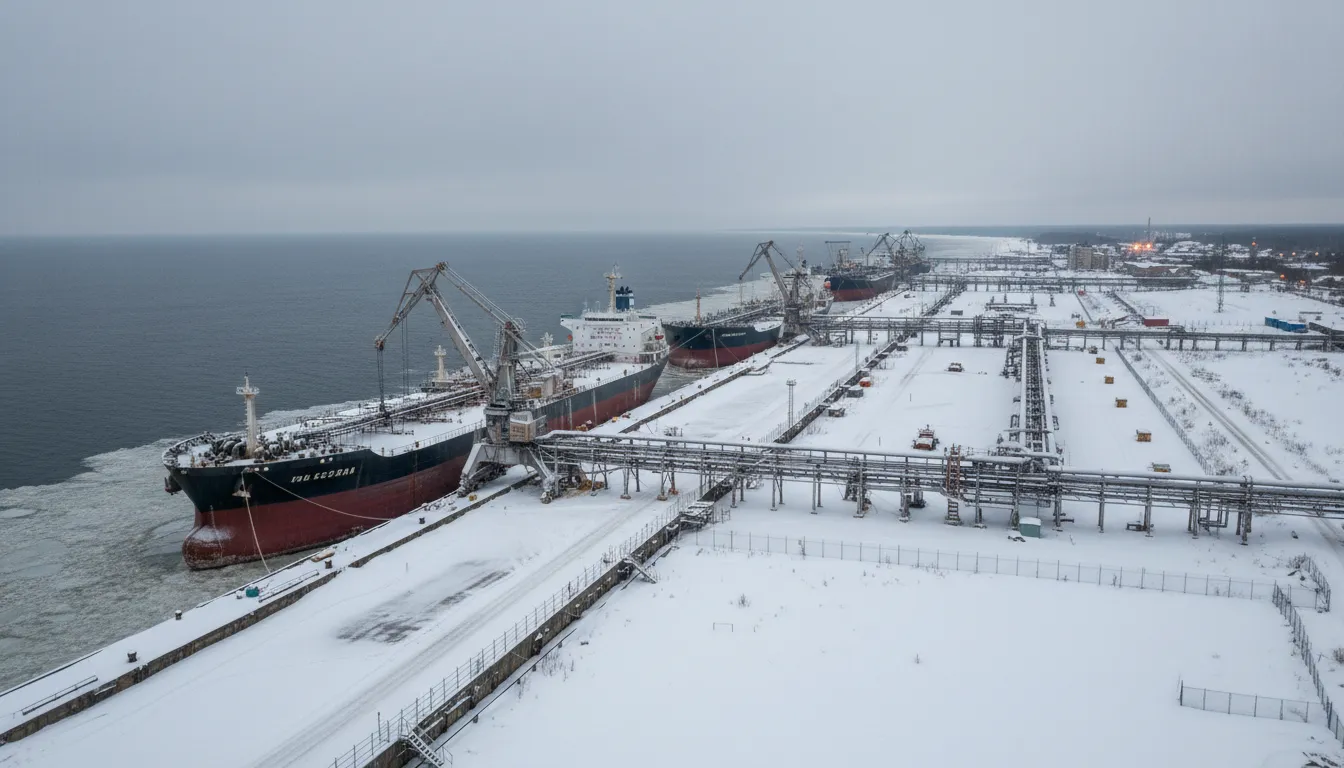
While the gasoline ban addresses domestic supply management, Russia faces a far more acute problem on the crude oil export front. Reuters calculations indicate that roughly 40% of Russia's Baltic Sea oil export capacity went offline last week, the result of a cascading series of disruptions across ports, pipeline feeds, and tanker operations in the region.
Ukrainian long-range drone strikes have been a primary driver of the outages. Attacks targeting Baltic port infrastructure and oil terminal facilities have forced extended shutdowns at loading berths that handle a significant share of Russia's westward crude export volumes. The Primorsk and Ust-Luga terminal complexes, which together account for the bulk of Baltic loadings of Urals crude, have both reported reduced operational capacity in recent weeks as operators conduct damage assessments and repairs.
Pipeline complications have added to the disruption. The Druzhba pipeline system, which feeds crude from western Siberia toward Baltic export terminals, has experienced pressure anomalies and reduced throughput in segments affected by the conflict environment, limiting the volume of oil that can be staged for export even at terminals that remain partially operational. Tanker-related issues—including difficulties securing vessels willing to transit the region under tightened insurance conditions—have further crimped loading schedules.
"Russia cannot take advantage of higher prices because it cannot get the barrels to market. The Baltic disruptions are costing Moscow hundreds of millions of dollars per week in lost revenue at precisely the moment global prices are most favorable." — Senior energy analyst, European commodities consultancy
The Cruel Irony of Elevated Prices
The timing of the Baltic capacity losses could scarcely be worse for Moscow from a revenue standpoint. Global oil prices have surged sharply in recent months, driven by escalating conflict in the Middle East and supply concerns across multiple producing regions. Brent crude has been trading well above recent norms, offering Russian producers the highest international price realizations in years—on paper. In practice, the export capacity outages mean that a substantial share of Russian production has nowhere to go.
India has emerged as Russia's most important crude customer since Western sanctions reshaped trade flows following the 2022 invasion of Ukraine. Indian refiners have shown a consistent appetite for discounted Urals barrels, and Moscow had been counting on sustained Indian demand to absorb its westward export volumes rerouted through alternative channels. But with Baltic loading capacity compromised, Russia's ability to fulfill contracted volumes with Indian buyers is being tested, and the logistical complexity of shifting crude from Baltic terminals to Arctic or Black Sea alternatives adds both cost and time to already strained supply chains.
Middle East Tensions Layer Additional Pressure
The Middle East geopolitical backdrop is providing a paradoxical backdrop to Russia's export difficulties. Heightened regional tensions have been a principal driver of the price rally that has pushed Brent and WTI sharply higher—the same rally that would normally benefit Russian exporters. Instead, Russia finds itself in a position where it is contributing to global supply anxiety through its own export disruptions while simultaneously being unable to profit from the price environment its dysfunction has helped create.
The conflict dynamics in the broader region have also raised questions about insurance and shipping availability for Russian cargoes. The "shadow fleet" of tankers that Russia assembled to circumvent Western sanctions-related shipping restrictions has faced growing scrutiny from port authorities in transit countries, and several vessels have been detained or delayed on administrative grounds, further constraining the throughput of Russian crude reaching global markets.
Domestic Market Rationale and Seasonal Demand
The gasoline export ban reflects a well-established pattern in Russian energy policy: when international prices rise sharply, the government moves to prevent domestic shortages by restricting exports of refined products. The agricultural calendar is particularly relevant. Spring planting season runs from April through June across Russia's major grain-producing regions, and diesel and gasoline consumption by farm machinery spikes during this window. Any domestic supply crunch during the planting season would carry significant economic and political costs.
Refinery runs across Russia have also been disrupted by Ukrainian drone strikes targeting refinery infrastructure, a campaign that began in earnest in 2024 and has continued into 2026. Several major refineries have operated at reduced capacity for extended periods following attacks, constraining domestic refined product output and making the government doubly cautious about allowing what production does reach the market to flow abroad rather than into the domestic distribution system.
Market Implications
For global oil markets, the twin Russian disruptions—the gasoline export ban and the Baltic capacity outages—add to an already complex supply picture. The Baltic outages in particular reduce the effective global supply of Urals crude available to price-sensitive buyers in Asia and Europe, providing incremental support to benchmark prices at a time when markets are already absorbing the premium associated with Middle East instability.
Traders will be monitoring several developments closely in the days ahead: the pace of repairs at Baltic loading terminals, any escalation in Ukrainian drone activity targeting energy infrastructure, and whether Russian officials signal any intention to further tighten refined product export restrictions beyond the July 31 gasoline ban deadline. Any extension of restrictions into the autumn heating season would carry considerably more market weight than a summer-focused measure tied to agricultural demand.
For now, Russia remains caught between two compounding pressures—a domestic market that requires protection from a high-price international environment, and an export infrastructure too damaged to fully access that environment regardless. The result is a significant constraint on Moscow's hard-currency revenues at a moment when those revenues are most needed.