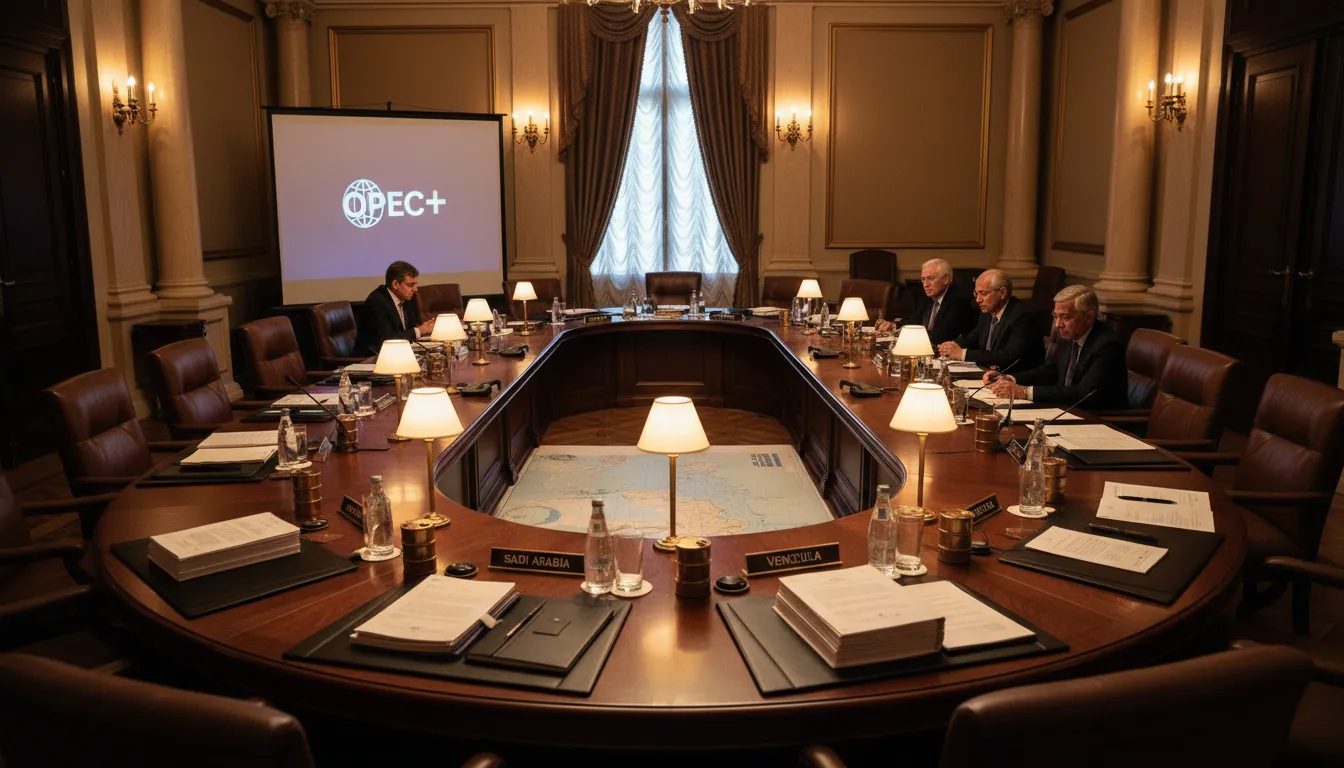
OPEC+ is preparing to announce another production increase this Sunday even though the barrels it pledges cannot currently reach the market. With the Strait of Hormuz effectively closed by the U.S.-Israeli military conflict with Iran, the alliance's eight core members are crafting what industry observers have taken to calling "paper oil" — production quotas that exist on spreadsheets but cannot be shipped until the world's most critical oil chokepoint reopens.
The move follows a 206,000 barrel-per-day increase the group approved for April. According to multiple sources cited by Reuters, the coalition is expected to endorse a comparable hike for May, maintaining its position that it stands ready to flood the market with additional supply the moment tanker traffic resumes through the Persian Gulf corridor. The decision underscores how thoroughly the conflict has decoupled OPEC+ policy from actual physical flows.
A Chokepoint That Carries a Fifth of Global Oil
The Strait of Hormuz — the narrow passage between the Omani and Iranian coastlines at the mouth of the Persian Gulf — ordinarily handles more than 20% of global seaborne oil flows. Every major Gulf producer depends on it to varying degrees. Saudi Arabia, Iraq, Kuwait, and the United Arab Emirates have all been forced to curtail exports since hostilities escalated, removing millions of barrels per day from an already tight global market and pushing crude prices toward $120 per barrel.
The physical reality is stark: OPEC+ members collectively hold substantial spare capacity, but spare capacity is only meaningful if the crude can be loaded onto tankers and delivered to refiners. Right now, for the Gulf's biggest producers, it largely cannot. The Strait closure has introduced a form of involuntary export embargo that no quota decision can override.
The Logic of Acting "At Least on Paper"
So why announce a production increase at all? OPEC+ insiders offer a straightforward rationale: the alliance needs to signal to markets that it has the supply available and the political will to deploy it, even if the timing remains uncertain. One source quoted by Reuters put it plainly, saying the group needs to act "at least on paper." Another emphasized that the market requires every available barrel, even if those barrels cannot transit the Strait today.
"The market requires every available barrel. We need to act at least on paper so that when the Strait reopens, there is no delay in getting supply to where it is needed." — OPEC+ delegate, via Reuters
The forward guidance serves a purpose beyond optics. By pre-authorizing increases now, OPEC+ avoids the lag time of convening an emergency session after the waterway clears. The moment conditions allow, producers can begin ramping shipments immediately rather than waiting for a political process to catch up with events. In a conflict environment where ceasefires can materialize quickly or not at all, that operational flexibility has real value.
Energy Aspects, the London-based energy consultancy, expects a May increase of roughly 206,000 bpd — mirroring the April authorization — but characterized the announcement as "largely academic" while the disruption persists. The firm's assessment reflects a broader market consensus: OPEC+ quotas are currently more relevant as signals than as supply instruments.
Spare Capacity Is Unevenly Distributed
The crisis has exposed a structural fault line within OPEC+ itself. Not all members are equally constrained by the Strait closure, and not all members have meaningful spare capacity to offer even if they were unconstrained.
Russia, Kazakhstan, Algeria, and Oman sit outside the Persian Gulf and are not directly affected by the waterway shutdown. Their exports continue to flow — through the Black Sea, the Caspian pipeline system, the Mediterranean, and the Indian Ocean respectively — but their collective production flexibility is limited. Russia is already pumping close to its quota ceiling and faces Western sanctions that complicate rapid output expansions. Kazakhstan has its own pipeline constraints. Algeria and Oman are mid-sized producers without the capacity buffers that Saudi Arabia or the UAE carry.
The Gulf producers, by contrast, hold the bulk of OPEC+'s latent capacity but are the ones most directly hamstrung by the Strait closure. Saudi Arabia's ability to sustain its customary role as the group's swing producer is currently a function of alternative routing rather than production limits.
Alternative Routes Under Maximum Pressure
Saudi Arabia has responded to the crisis by pushing crude through its East-West Pipeline, the cross-peninsula artery that connects its Eastern Province oil fields to the Red Sea port of Yanbu. Throughput on the pipeline has been ramped toward its rated capacity of approximately 5 million barrels per day, with current flows approaching 4.6 million bpd — a near-maximum utilization rate that leaves little additional headroom.
The United Arab Emirates has similarly leaned on its Habshan-Fujairah pipeline, which bypasses the Strait entirely by moving crude from Abu Dhabi's inland fields to the UAE's east coast terminal at Fujairah. That facility recorded approximately 1.61 million barrels per day in March exports, operating at the upper end of its sustained capacity. Both pipelines are functioning as pressure relief valves, but their combined throughput falls well short of the Gulf's pre-crisis export volumes.
"Saudi Arabia and the UAE deserve credit for activating their bypass infrastructure rapidly, but the arithmetic is unforgiving. The Strait handles flows that no combination of pipelines can fully replace on short notice." — Senior analyst, international energy consultancy
Could OPEC+ Actually Pause Production?
Despite the forward-leaning rhetoric, a production pause remains a live possibility within OPEC+ discussions. If the Strait closure extends for weeks or months rather than days, the economic logic of approving increases that cannot be monetized begins to erode. Some delegates have privately acknowledged that announcing repeated output hikes while exports stall creates a credibility problem: markets may begin discounting OPEC+ quota decisions as purely political gestures disconnected from physical reality.
A pause would allow the alliance to conserve the signal value of its production decisions, re-deploying them as genuine market-moving announcements once the Strait reopens. It would also avoid the awkward optics of building paper inventories that never actually materialize as delivered barrels. The decision this Sunday will offer the clearest indication yet of which faction within OPEC+ holds the upper hand: the one that wants to maintain the appearance of assertive supply management, or the one that prefers to wait for conditions in which its decisions carry real weight.
Market Impact and the Path Forward
For energy markets, the immediate consequence of OPEC+'s Sunday decision is likely to be muted. Traders have already largely priced in the expectation of paper increases that cannot be physically executed under current conditions. The more significant price catalysts in the near term remain the diplomatic track — any credible signal of de-escalation between the United States and Iran would send crude sharply lower — and the operational status of the bypass pipelines, where any disruption or capacity degradation would tighten the market further.
Crude at $120 represents a market that has absorbed the supply shock but has not yet fully priced a prolonged closure scenario. If the Strait remains shut through the summer driving season, additional upward pressure is likely. Conversely, a rapid resolution could release a wave of pent-up Gulf supply that pushes prices back toward the $90–$100 range within weeks. OPEC+'s paper barrels are, in that sense, a coiled spring: irrelevant today, potentially decisive tomorrow.