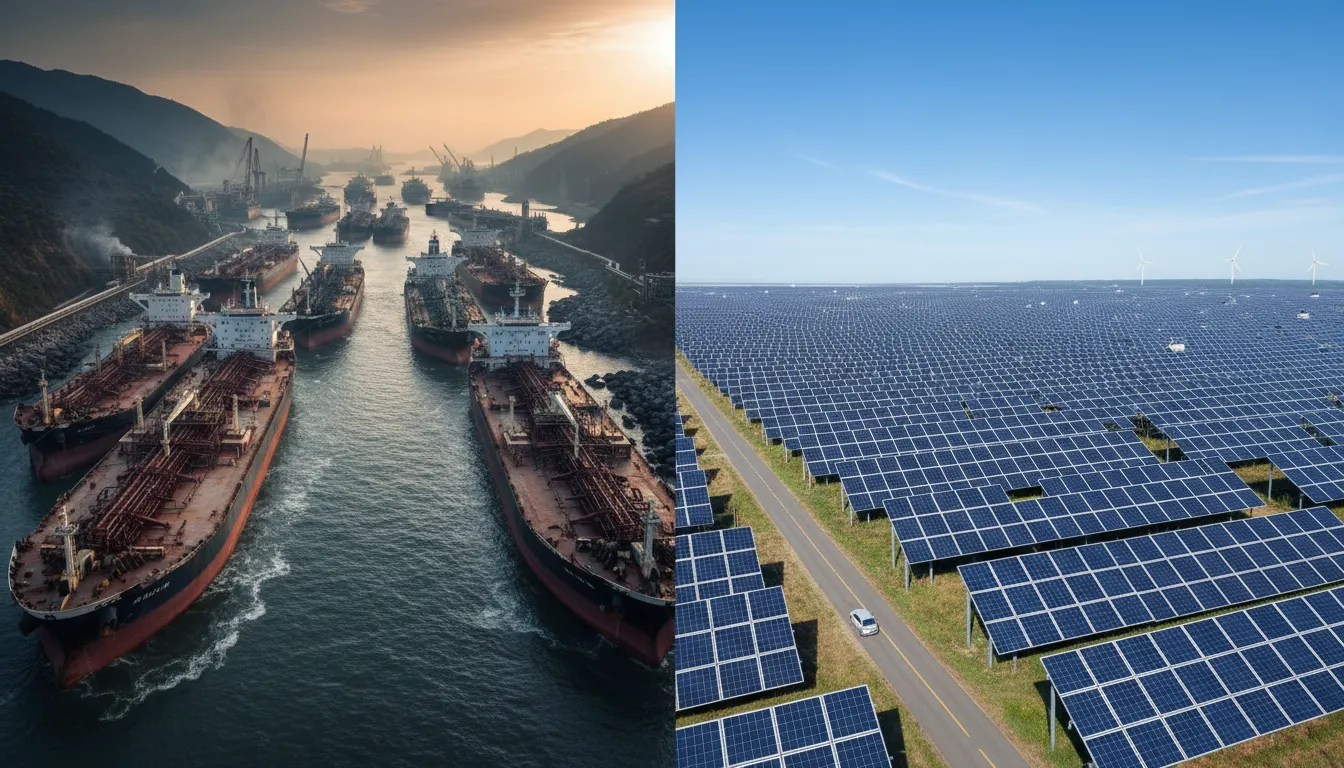
The blockade of the Strait of Hormuz has cut off roughly one-fifth of the world's seaborne oil and gas shipments, making it the single-largest disruption to global oil commerce in recorded history. Yet for all its severity, the economic damage is running markedly below the catastrophic levels seen during past energy shocks—and a global electricity system that looks fundamentally different from the one that existed fifty years ago is a central reason why.
"There is little sign that the war with Iran will cause the kind of economic pain experienced about a half-century ago, when oil met almost half of the world's energy needs."
That comparison is the key to understanding why $100-plus crude, while deeply painful at the pump, has not yet triggered the kind of demand destruction and recession cascade that marked the 1973 Arab oil embargo or the 1979 Iranian Revolution shock. The world simply runs on a more diversified energy diet today—and solar power, in particular, has grown from a niche technology into a genuine structural pillar of global electricity supply.
Solar's Decade of Exponential Growth
The scale of solar's expansion over the past decade is difficult to absorb in a single sitting. In 2015, solar represented just 1 percent of global electricity generation, with installed capacity of 228 gigawatts. By 2025—only ten years later—that figure had climbed to 2,919 gigawatts, accounting for approximately 9 percent of worldwide electricity output and surpassing nuclear power's contribution to the grid for the first time. The cost of utility-scale solar fell by more than 90 percent over the same period, a learning-curve trajectory that no conventional energy source has ever matched.
Industry analysts now project continued exponential expansion. Current forecasts place global solar capacity at roughly 9,000 GW by 2030, a level sufficient to satisfy over 20 percent of total global energy demand. That trajectory, if sustained, would mean that within four years solar alone offsets a share of global energy consumption comparable in size to the entire supply disruption now flowing from the Hormuz blockade.
The Economics of Diversification
Research from Finland's Lappeenranta-Lahti University of Technology has quantified what an economically optimal global energy system would actually look like, and the findings are striking: 76 percent solar, 20 percent wind, with the remaining 4 percent sourced from hydropower, biomass, and geothermal. That model was constructed on pure cost-optimization grounds—no policy preferences, no ideological assumptions—and it arrives at a grid dominated by solar simply because solar has become the cheapest large-scale electricity source available across most of the globe.
The practical implication for the current crisis is significant. Electricity that is generated from sunlight cannot be blockaded. Refineries, petrochemical plants, and industrial operations that have invested in on-site or grid-connected solar capacity over the past decade are insulated from the crude price spike in ways that their predecessors in 1973 or 1979 were not. The more of a nation's energy mix that runs on electrons rather than barrels, the less exposed its economy is when a chokepoint like Hormuz goes dark.
China's Manufacturing Dominance Fuels Global Adoption
More than 80 percent of the world's solar panels currently originate from Chinese manufacturing facilities, and the cost advantage that concentration has produced has been the single largest driver of solar's global adoption. Panel prices that would have seemed impossibly low a decade ago are now standard, and they have made solar economically viable not only in the wealthy, high-subsidy markets of Europe and North America but across the developing world—where the current oil shock is landing with particular force on import-dependent economies.
The implications cut in two directions. On one hand, China's dominance in solar manufacturing represents a strategic concentration risk that Western policymakers have flagged repeatedly. On the other, the sheer volume and affordability of panels flowing out of Chinese factories has accelerated the global energy transition faster than any policy mechanism alone could have achieved—and that acceleration is now functioning as a partial economic buffer during the worst oil supply crisis in a generation.
Emerging Markets Are Moving Fastest
One of the more counterintuitive findings of the current moment is where the energy transition is advancing most rapidly. Developing nations are deploying solar infrastructure at unprecedented speeds, often bypassing the legacy grid buildout phase entirely. An Oxford University study demonstrates that low- and middle-income countries can achieve potential GDP gains of around 10 percent through renewable adoption, with minimal market barriers compared to the institutional friction that slows deployment in more established economies.
Countries including Brazil, Chile, El Salvador, Morocco, Kenya, and Namibia have already outpaced United States clean energy progress on key per-capita metrics. Perhaps most remarkably, 63 percent of emerging markets across Africa, Asia, and Latin America now generate greater solar capacity relative to their size than the United States. Pakistan has become one of the world's largest new solar adopters, driven not by policy mandates but by straightforward economics: localized solar-plus-battery systems have become cheaper and more dependable than connection to the national grid for tens of millions of households and businesses.
These countries were among the most vulnerable to oil price shocks historically, given their dependence on imported crude and their limited ability to cushion consumers from price spikes. The rapid build-out of domestic renewable capacity is, in real time, reducing that vulnerability—a structural shift whose full significance is only becoming apparent now that a genuine supply crisis has arrived.
The Strategic Dimension: Energy That Cannot Be Weaponized
Beyond the economics, the current crisis has sharpened a strategic argument that renewable energy advocates have made for years but that policymakers have often treated as secondary to cost and reliability concerns.
"Wind and solar cannot be embargoed, blockaded, or shut off by a foreign power. Every terawatt-hour of domestic renewable generation is a terawatt-hour that no adversary can weaponize." — David Frykman, venture capital investor
That observation, once a rhetorical point in clean energy debates, reads differently when a hostile power controls the world's most critical oil transit chokepoint. The nations that have invested most aggressively in domestic renewable capacity over the past decade are demonstrably better positioned today than those that deferred the transition in favor of cheap imported oil. The geopolitical dividend of energy independence, long theorized, is now being stress-tested in real conditions.
The Limits of the Buffer
None of this is to suggest that solar has neutralized the Hormuz crisis. Crude oil prices above $100 per barrel are genuinely damaging. Gasoline above $4.00 per gallon hits consumers directly and regressively. Diesel at $5.50 per gallon raises costs across every sector of the economy that moves physical goods. Aviation fuel surcharges are already flowing through to ticket prices. The supply shock is real, and its full effects on inflation and growth will take months to become visible in the economic data.
The argument is more specific: the damage is structurally less severe than it would have been if this crisis had occurred in 2005, or 1995, or 1975, because oil's share of total energy consumption has declined significantly—and solar, wind, and other renewables have absorbed a meaningful portion of the demand that petroleum once monopolized. The cushion is imperfect and unevenly distributed, but it exists, and it is larger than most market participants had priced in before the blockade began.
The deeper lesson may be that the energy transition, often framed as a decades-long project still in its early chapters, has already progressed far enough to alter the macroeconomic math of an oil supply shock. That is a structural change in the global economy—one that is only becoming fully legible now that the shock it was quietly hedging against has finally arrived.