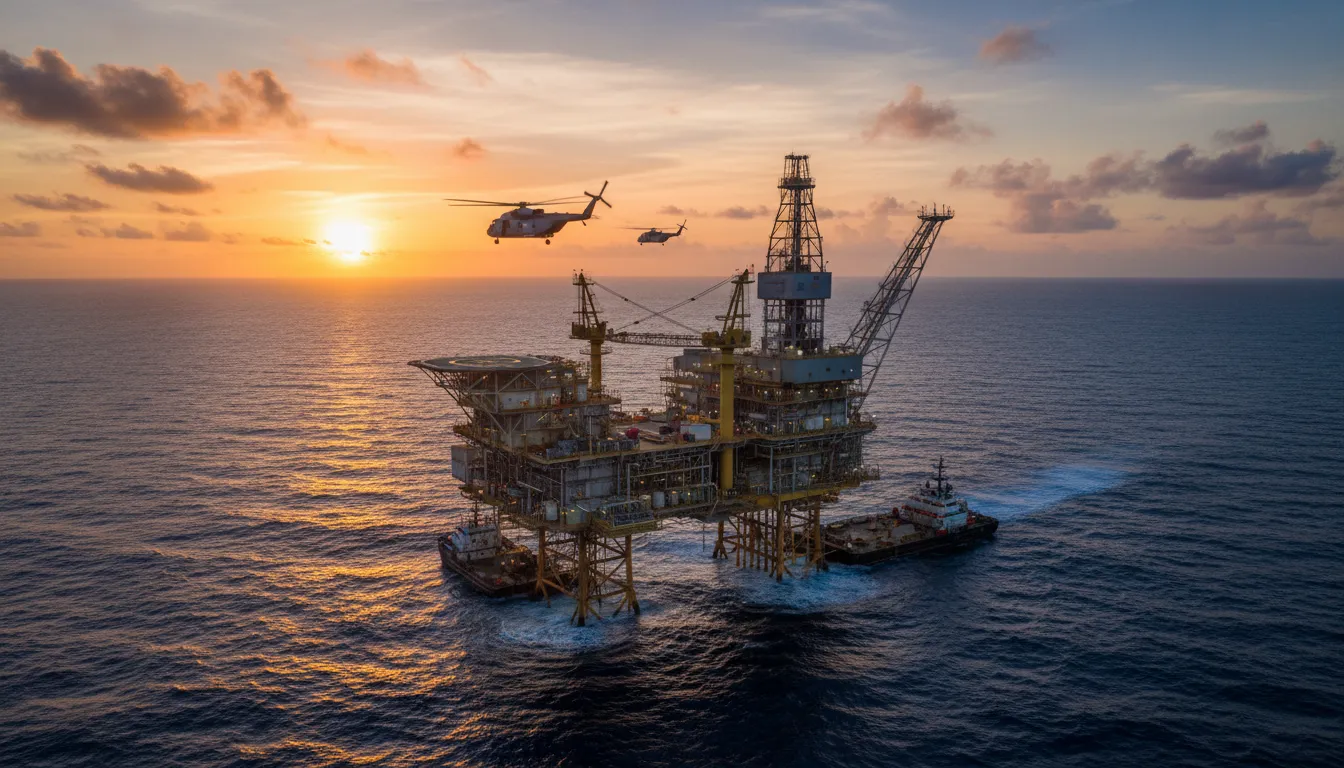
Five of the world's largest oil companies are circling a single deepwater asset in the U.S. Gulf of Mexico, a convergence that would have seemed improbable just months ago but now reflects the brutal arithmetic of a global supply crisis. TotalEnergies, Shell, BP, Repsol, and Chevron are all understood to be evaluating a bid for the 51% controlling stake in the Shenandoah field currently held by Beacon Offshore Energy and HEQ Deepwater — and the urgency driving their interest has everything to do with what is no longer flowing out of the Middle East.
The Asset at the Center of the Scramble
The Shenandoah field sits in the deep waters of the Gulf of Mexico and reached its target production rate of 100,000 barrels per day in late 2025, hitting that milestone within just 75 days of initial oil production. That ramp-up speed is exceptional for a deepwater development of this scale, and it has not gone unnoticed by majors suddenly desperate to secure reliable barrels outside the Persian Gulf corridor.
Beacon Offshore Energy, which is backed by private equity firm Blackstone, holds its interest alongside HEQ Deepwater — a joint venture between Quantum Capital Group and Houston Energy. Israel's Navitas Petroleum retains the remaining 49% stake in the project and is not part of the current sale process. The sellers are now inviting formal bids, with offers anticipated within weeks according to people familiar with the process.
"The Shenandoah ramp-up underscores the capability of the Shenandoah system." — Beacon Offshore Energy spokesperson
Beyond its current output, Shenandoah carries significant expansion optionality. Development plans call for raising production capacity to 140,000 barrels per day through the drilling of two additional development wells, adding further appeal to an acquisition that is already commanding unusual attention across the industry.
Why Now: 11 Million Barrels a Day Off the Market
The intensity of bidder interest cannot be understood without reference to the supply shock that has reshaped global crude markets since late March. U.S. and Israeli military action against Iran has effectively removed approximately 11 million barrels per day of crude oil from global markets — a figure that encompasses not only Iran's direct production but also the severe disruption to tanker transit through the Strait of Hormuz, through which roughly 20% of the world's seaborne oil normally passes.
The scale of that withdrawal is without modern precedent. Even at the height of the 1990 Gulf War, when Iraqi and Kuwaiti production was knocked offline simultaneously, the combined loss represented roughly 4–5 million barrels per day. The current disruption is more than double that, and it shows no signs of rapid resolution. With Brent and WTI both trading above $100 per barrel and supply chains across Asia and Europe scrambling for alternative cargoes, every proven, producing barrel outside the Gulf has taken on an entirely new valuation.
"Safe barrels — barrels that don't transit the Strait of Hormuz and aren't subject to sanctions risk — are worth a substantial premium right now. The Gulf of Mexico has become the most strategically important producing basin in the world almost overnight." — Senior energy analyst, major European investment bank
The Bidder Field and What Each Company Stands to Gain
The reported bidder list reads like a who's-who of international oil, and each name brings a distinct strategic rationale. TotalEnergies and Shell, the two companies reported to be leading the process, have both been vocal about the need to secure advantaged barrels that can be delivered profitably across a wide range of price environments. Both companies already have significant Gulf of Mexico exposure and the technical infrastructure to integrate a Shenandoah acquisition without meaningful operational friction.
BP, still navigating a multi-year portfolio restructuring, would view Shenandoah as an opportunity to add high-quality production with near-term expansion potential at a moment when the market is rewarding reserve addition more generously than at any point since 2014. Repsol, which has been selectively building its deepwater Americas portfolio, and Chevron, which operates extensively in the Gulf of Mexico and has the project management depth to rapidly advance the 140,000-barrel expansion, round out a bidder field that may yet grow. Sources indicate that prospective buyers from the Middle East — sovereign-backed entities seeking to diversify their own upstream positions — could also emerge as the process matures, though some parties currently evaluating the asset may ultimately decide against submitting a formal offer.
Market Impact
The Shenandoah sale process is unfolding against a broader market backdrop defined by acute scarcity and a fundamental repricing of geopolitical risk across the energy complex:
- Brent Crude: Trading above $100 per barrel as the Middle East supply disruption removes roughly 11 million barrels per day from global markets, with the forward curve in deep backwardation signaling sustained tightness.
- WTI Crude: Moving in tandem with Brent, with U.S. Gulf of Mexico production now commanding a structural strategic premium as buyers seek to replace lost Persian Gulf cargoes.
- Gulf of Mexico Assets: Valuations for producing deepwater assets in the U.S. Gulf have re-rated sharply. Assets that might have traded at six to eight times EBITDA in 2025 are now attracting interest at multiples well above that range.
- M&A Activity: The Shenandoah process is likely a bellwether for a broader wave of upstream dealmaking as majors and national oil companies seek to acquire secure, non-OPEC production in stable jurisdictions.
- Deepwater Development Capital: Rig day rates and subsea equipment lead times are extending as operators accelerate development timelines across the Gulf of Mexico, Brazil's pre-salt, and West Africa.
What to Watch
The Shenandoah sale will serve as a real-time indicator of how the market is pricing supply security in the current environment. Several developments will determine both the outcome of this specific process and its broader implications for the upstream M&A landscape:
- Formal bid submissions from TotalEnergies, Shell, BP, Repsol, and Chevron, expected within weeks, will establish a market-clearing price for premium Gulf of Mexico production in a supply-crisis environment
- Whether Middle Eastern sovereign-backed entities enter the process, which would significantly expand the bidder pool and likely push valuations higher
- Progress — or lack thereof — on any diplomatic resolution to the Iran conflict, which remains the single largest variable determining the strategic value of non-Gulf barrels
- Beacon Offshore and HEQ Deepwater's timeline for drilling the two additional development wells needed to reach the 140,000-barrel-per-day expansion target, which will factor heavily into buyer valuations
- IEA and OPEC+ emergency supply response measures, including strategic reserve releases and production ramp-up commitments from Saudi Arabia, the UAE, and Iraq, which could partially offset the Iranian supply loss and moderate the urgency premium built into current bid valuations
- U.S. regulatory posture toward foreign acquisition of domestic upstream assets, particularly by Middle Eastern state-backed entities, given the current geopolitical climate
With five of the world's most sophisticated energy companies converging on a single 100,000-barrel-per-day field, the Shenandoah auction has become something larger than a routine asset sale. It is a direct measure of how the industry is pricing the new world order in global oil supply — one in which geographic security, jurisdictional stability, and the absence of Strait of Hormuz exposure have become as important to deal economics as the underlying resource itself. Whatever price is ultimately paid, it will set a benchmark that shapes upstream investment decisions and M&A valuations across the non-OPEC producing world for years to come.