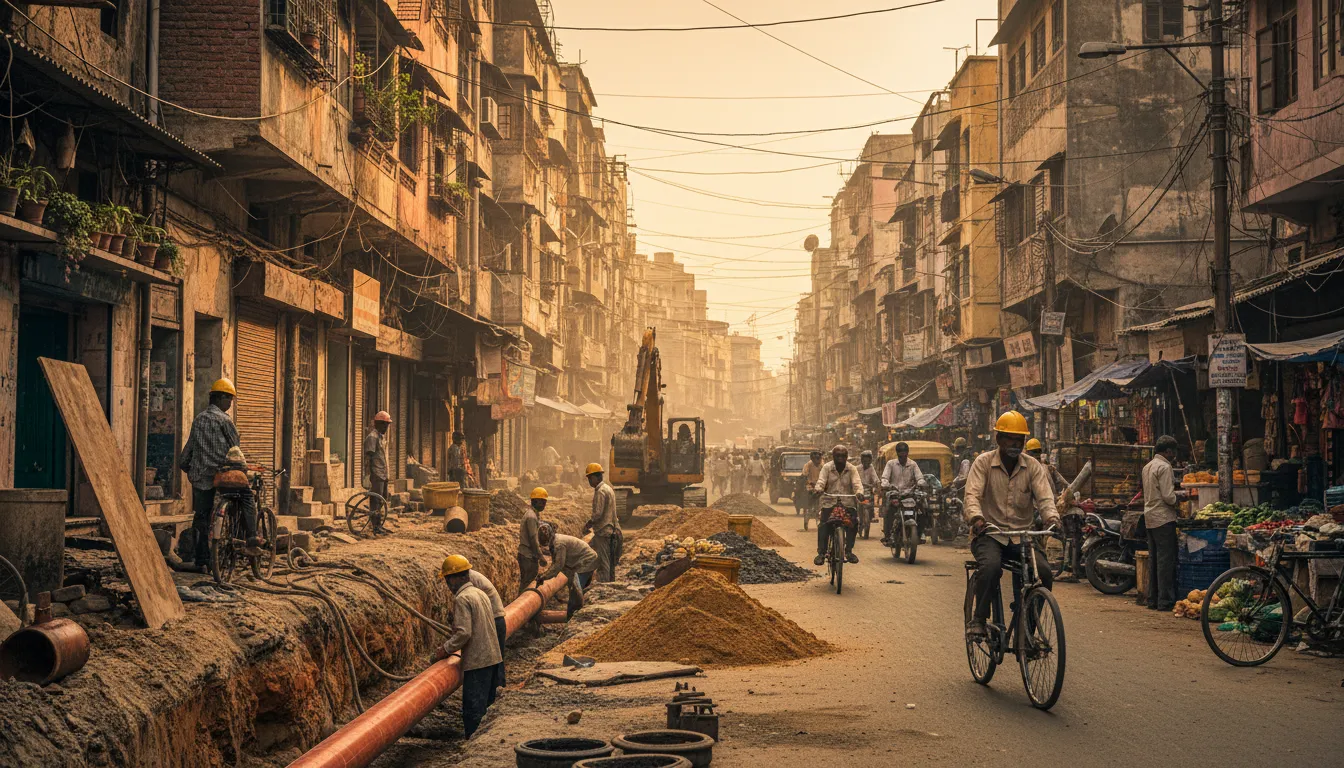
India is moving swiftly to expand its piped natural gas (PNG) network as the country faces a severe shortfall in liquefied petroleum gas supplies triggered by the ongoing conflict in the Middle East. The blockage of the Strait of Hormuz — through which roughly 90% of India's LPG imports normally flow — has created an immediate and widespread domestic fuel crisis, with around 60% of Indian households dependent on LPG cylinders as their primary cooking fuel.
The Hormuz Bottleneck and Its Domestic Fallout
The Strait of Hormuz, the narrow waterway separating the Persian Gulf from the Gulf of Oman, is one of the world's most strategically critical energy chokepoints. Under normal conditions, India sources the majority of its LPG from Gulf producers including Saudi Arabia, the UAE, Kuwait, and Qatar. With tanker traffic through the strait severely curtailed since the outbreak of hostilities, Indian state refiners and importers have been unable to maintain their typical import volumes, sending domestic LPG prices sharply higher and forcing the government to intervene with emergency rationing measures.
In response, authorities have imposed sharp cuts to LPG allocations for commercial establishments and industrial consumers, including hotels, restaurants, bakeries, and small manufacturing units, in order to redirect the available supply toward residential households. While the measure offers some relief to the roughly 300 million households that use LPG, industry groups have warned that the commercial rationing is squeezing margins across the food service and hospitality sectors at a particularly difficult time.
"The priority right now is ensuring that ordinary families can cook their meals. Commercial and industrial users have more flexibility to adapt to alternative fuels or modify operations in the near term." — Senior official, Ministry of Petroleum and Natural Gas
PNG as the Long-Term Answer
The crisis has given renewed urgency to India's piped natural gas program, which connects households and businesses directly to the gas grid and eliminates reliance on imported LPG cylinders. India's City Gas Distribution (CGD) network — overseen by the Petroleum and Natural Gas Regulatory Board (PNGRB) — has been expanding steadily over the past decade, but coverage remains heavily skewed toward major metropolitan areas. As of early 2026, PNG connections had been rolled out to roughly 120 cities and geographic areas, leaving vast swathes of semi-urban and rural India without access.
The government has now directed state-owned gas utilities including GAIL (India) Ltd., Indraprastha Gas Limited (IGL), and Mahanagar Gas Limited (MGL) to accelerate the laying of last-mile distribution pipelines, with a particular focus on Tier 2 and Tier 3 cities where LPG dependency is highest. Officials say targeted subsidies and low-cost connection schemes will be deployed to drive rapid household uptake once the infrastructure is in place.
The transition also carries a broader energy security rationale that goes beyond the immediate crisis. Domestic natural gas production from fields such as the KG-D6 basin off India's east coast, combined with contracted LNG imports on longer shipping routes from the United States, Australia, and East Africa, can partially substitute for Gulf-sourced LPG — though industry analysts caution that building the physical distribution infrastructure will take months to years, not weeks.
Supply Alternatives and Emergency Procurement
In parallel with the push for piped gas, New Delhi has launched emergency procurement efforts to source LPG from alternative suppliers not reliant on Hormuz transit. Shipments from the United States, Nigeria, and Algeria — whose LPG exports travel via the Atlantic and around the Cape of Good Hope — have been booked on short notice at significant premiums. Indian Oil Corporation (IOC) and Bharat Petroleum Corporation Limited (BPCL) have both confirmed they are in active negotiations for spot cargoes to partially offset the supply gap.
The longer routing adds roughly two to three weeks to transit times compared with Gulf shipments, and freight costs have surged on the affected trade lanes. As a result, the landed cost of imported LPG has climbed sharply, placing further strain on the government's subsidy bill. India has historically subsidised LPG prices for domestic consumers, and analysts estimate the current supply crunch could add tens of billions of rupees to the subsidy burden in the near term unless international prices moderate.
Market Impact
The disruptions have reverberated across the broader energy complex. Asian LPG spot markets have tightened considerably, with propane and butane prices rising to multi-year highs as regional buyers compete for non-Hormuz supply. The supply squeeze has also supported Brent crude prices, which remain elevated on persistent uncertainty over Gulf production and export flows.
- Brent Crude: Trading near elevated levels as Hormuz transit risk sustains a geopolitical risk premium in the market.
- WTI: Tracking Brent higher with the broader Middle East disruption narrative intact; spread remains within typical bounds.
- LPG / Asian Propane: Spot prices at multi-year highs on tight regional supply; freight premiums on Atlantic basin cargoes widening significantly.
- Natural Gas: Indian domestic gas demand outlook improves on accelerated PNG expansion, adding modest support to long-term contract pricing.
Social and Political Pressure
The LPG crisis is generating significant political pressure inside India, where affordable cooking gas has been a flagship policy issue since the government's Pradhan Mantri Ujjwala Yojana scheme provided subsidised LPG connections to tens of millions of low-income households. Opposition parties have seized on the shortage and rising prices to challenge the ruling coalition, calling for greater transparency in emergency procurement and faster deployment of the PNG network to vulnerable communities.
Consumer advocacy groups have also raised concerns about the equitable distribution of available LPG stocks, noting that rural and peri-urban households — who tend to have less access to alternative cooking fuel options — are bearing a disproportionate share of the supply cuts. Several state governments have announced supplementary cash transfers to help lower-income families manage the higher costs while the PNG rollout catches up.
What to Watch
The pace of PNG infrastructure deployment in Tier 2 and Tier 3 cities will be the key metric to monitor in coming months. Investors and energy market participants should also track the status of Hormuz transit negotiations and any ceasefire or corridor agreements that could restore partial tanker flows. Any reopening of the strait — even on a limited basis — would likely ease near-term LPG price pressures across Asia significantly. Domestically, the PNGRB's next round of CGD licensing and any emergency capital allocation to gas utilities will signal how seriously New Delhi intends to pursue permanent energy security reform beyond the current crisis.