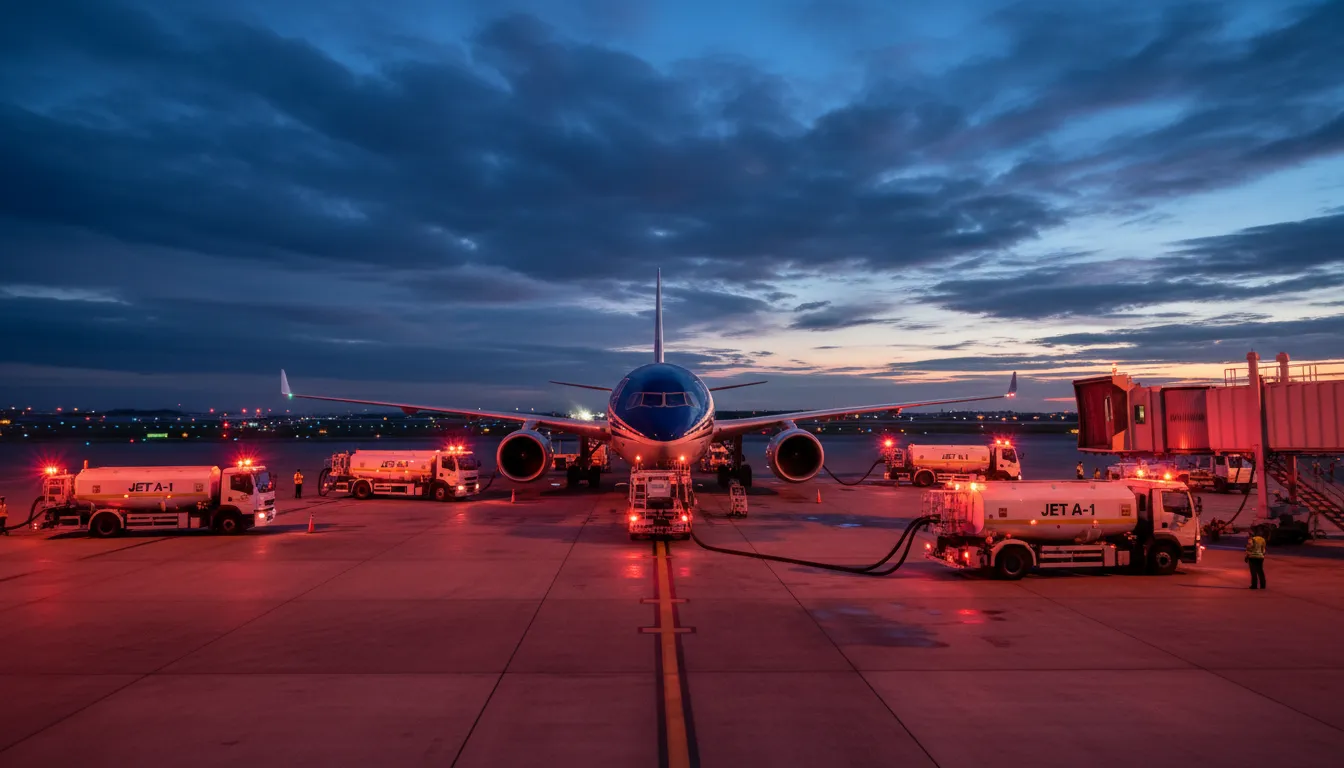
Jet fuel prices have more than doubled in the span of a single month, driven by the near-total seizure of oil and petroleum product flows through the Strait of Hormuz following the outbreak of U.S.-Iran hostilities. The price shock—unprecedented in its speed and severity—is pushing airlines across Asia, Europe, and North America into emergency cost-cutting mode, with carriers raising fares, grounding aircraft, and quietly cancelling routes as their fuel bills spiral out of control.
A Supply Crunch With No Easy Fix
Unlike crude oil, jet fuel cannot easily be sourced from alternative suppliers on short notice. It requires specialized tank storage, and global strategic reserves of aviation turbine fuel are minimal compared to those maintained for crude or diesel. The logistical reality is that airlines have almost nowhere to turn when their primary supply corridors are severed.
Analysts at Sparta Commodities have been among the most direct in characterizing the depth of the problem. The conflict has constrained Asian refinery run rates, with refiners in South Korea, Japan, and Singapore reducing throughput as their crude feedstock pipelines from the Gulf dry up. Several have implemented export restrictions to protect domestic aviation supply, tightening the global market further.
"No alternatives for production and no strategic storage." — June Goh, Senior Oil Market Analyst, Sparta Commodities
The structural mismatch between jet fuel demand and available supply is expected to worsen through May and June, as the summer travel season approaches in the Northern Hemisphere precisely when airlines can least afford to cut capacity. Even an immediate ceasefire and full reopening of the Strait of Hormuz would not resolve the crisis quickly. Supply chain normalization, analysts warn, would take three to six months to return to pre-war levels—a timeline that offers airlines no near-term relief.
"A global jet supply crunch is emerging with no clear relief mechanism." — James Noel-Beswick, Head of Commodities, Sparta Commodities
Airlines Respond With Emergency Measures
Carriers around the world have begun implementing measures that, until recently, would have been unthinkable outside the most extreme market conditions. The response has varied by airline size, hedging position, and geographic exposure, but the direction of travel is uniform: costs are rising faster than revenues, and hard choices are being made.
Ryanair CEO Michael O'Leary offered the starkest public account of the financial impact, disclosing that the carrier is paying nearly double its previous fuel costs on the portion of its consumption that remains unhedged. O'Leary confirmed Ryanair is paying approximately $150 per barrel for jet fuel on roughly 20% of its unhedged fuel exposure—a figure that, extrapolated across even a fraction of the airline's annual fuel bill, represents a material hit to profitability. The disclosure sent Ryanair shares sharply lower and prompted similar disclosures from competitors across Europe.
Lufthansa, Europe's largest airline group by passengers, has prepared contingency plans to ground approximately 40 aircraft—representing around 5% of its total operational capacity—if jet fuel prices remain at current levels through the second quarter. The groundings would be concentrated on long-haul routes with the highest fuel intensity per available seat kilometer, and would represent the largest voluntary capacity reduction by a European carrier since the pandemic.
In Asia, Korean Air entered what its management described as emergency management mode, convening a special task force to monitor fuel procurement on a daily basis and accelerating negotiations with fuel suppliers in markets outside the Persian Gulf corridor. Qantas, facing acute exposure given its hub in Sydney and its dependence on Gulf-region fuel stopover points, raised international fares in early March and has signaled further increases are likely if market conditions do not improve.
Demand Destruction Already Emerging
The combined effect of higher fares and reduced capacity is beginning to show up in booking data. Travel agencies across Europe and Southeast Asia have reported a noticeable softening in forward bookings for flights priced above certain fare thresholds, suggesting that price-sensitive leisure travelers are deferring or abandoning plans. Business travel, historically more resilient to fare increases, is holding up somewhat better, but even corporate travel managers are beginning to push back on fares that have climbed 30–60% on key international routes over the past six weeks.
The demand destruction dynamic is particularly acute in markets where aviation competes directly with high-speed rail for shorter journeys. In Europe, Eurostar and Thalys operators have reported a marked uptick in bookings on routes that parallel popular air corridors, as travelers opt for ground transport on routes where jet-fuel-inflated fares have eroded the price and convenience advantage of flying.
The Strait of Hormuz: Aviation's Chokepoint
The Strait of Hormuz has long been identified as the world's most critical energy chokepoint, carrying roughly 20% of global seaborne crude oil on a normal day. What was less widely appreciated before the current crisis was the degree to which the global aviation fuel supply chain runs through the same narrow waterway. The Gulf states—Saudi Arabia, the UAE, Kuwait, and Qatar in particular—are among the world's largest exporters of refined petroleum products, including jet fuel destined for major hub airports in Asia and Europe.
With those export flows disrupted, the aviation fuel market is experiencing a geographic imbalance that spot prices alone cannot resolve. U.S. refineries, which produce ample jet fuel, are not configured to easily redirect volumes to Asian markets on short notice, and Atlantic Basin jet fuel production is already stretched to meet European demand. The result is a market in which jet fuel is simultaneously abundant in some regions and critically scarce in others, with arbitrage flows constrained by tanker availability and shipping insurance costs that have surged along with the conflict premium.
Hedging Positions Now the Defining Variable
The crisis has exposed the full range of airline hedging strategies, and the divergence in outcomes is stark. Carriers with robust forward hedging programs locked in at pre-conflict prices are insulated from the worst of the spot market spike, at least through the middle of the year. Those that had reduced their hedge ratios—often a rational decision during the period of stable, lower oil prices that preceded the conflict—are now facing spot market purchases at levels that directly threaten their operating margins.
- Ryanair: Paying approximately $150 per barrel on 20% of unhedged fuel; emergency cost reviews underway across all departments.
- Lufthansa Group: Contingency plans to ground 40 aircraft (approx. 5% capacity) if current prices persist through Q2 2026.
- Korean Air: Formally entered emergency management mode; daily fuel procurement task force activated.
- Qantas: International fare increases implemented in early March; further increases flagged if market conditions hold.
The divergence in hedging coverage will likely define which carriers emerge from this crisis with balance sheets intact and which face structural financial damage. Airlines that entered the year with hedge ratios above 70% for the first half of 2026 have meaningful protection through at least mid-year. Those below 50% are effectively flying into the spot market headwind every day the conflict continues.
No Relief in Sight
With President Trump indicating that U.S. military operations against Iran are far from complete, and with the Strait of Hormuz effectively closed to normal commercial traffic, the energy market shock that has already pushed crude above $100 per barrel shows no sign of reversing. For the aviation industry, the compounding effect of a crude price spike, a refined product supply crunch, and a demand outlook that is beginning to weaken under the weight of higher fares creates a uniquely difficult operating environment.
Industry analysts expect further airline capacity announcements, additional fare surcharges, and potentially the first major carrier financial distress filing of the conflict period within the next 60 days if jet fuel prices remain near current levels. The summer travel season—historically the most profitable period of the year for most airlines—now looks likely to be defined not by passenger demand, but by how much fuel airlines can afford to burn.