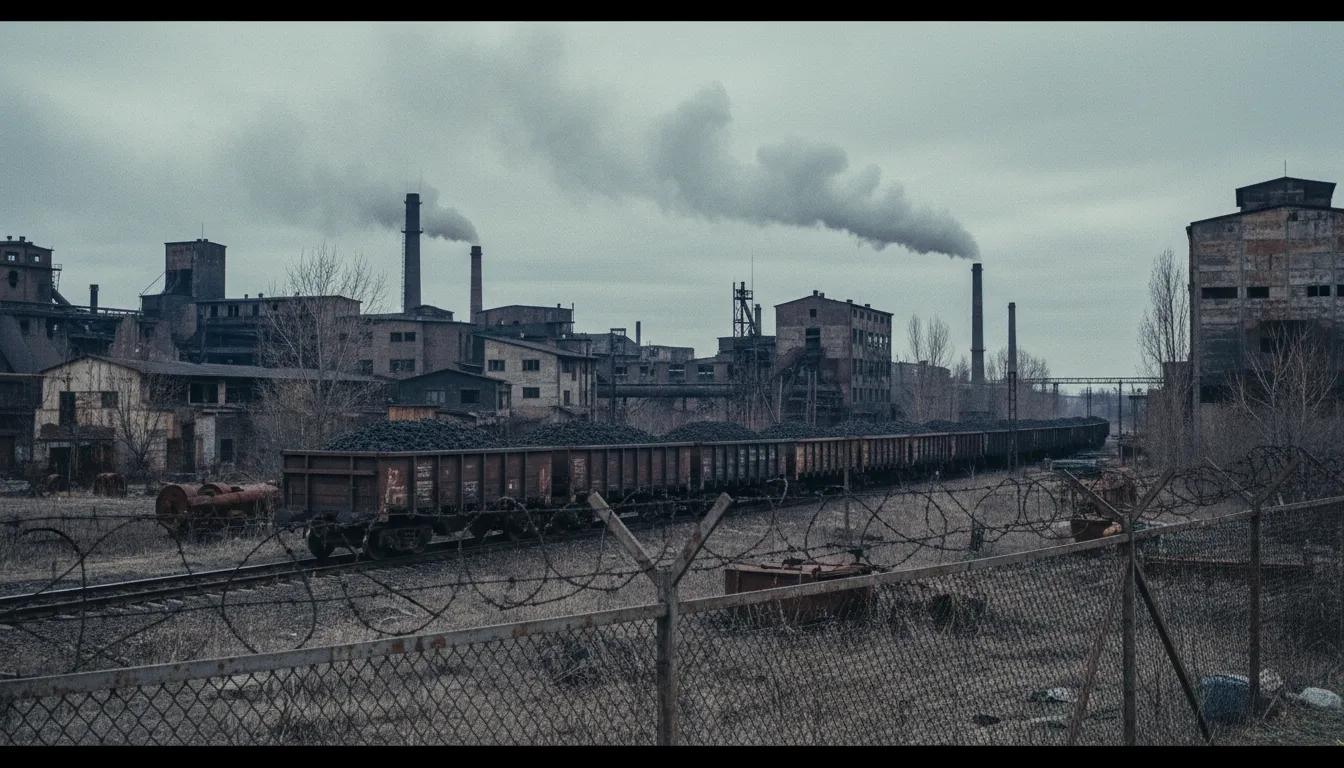
A Georgian company has reached a formal agreement to import coal, metals, and chemical products directly from Russian-occupied Donetsk, in a transaction that lays bare the persistent structural weaknesses in Western sanctions enforcement and signals a deepening commercial alignment between Tbilisi and Moscow. The deal, concluded by George Oil Ltd and its owner Valerian Kochiashvili, is being described by Kremlin-installed Donetsk authorities as an opening move in a broader normalization of trade with the occupied territories—a development that Western sanctions architects had explicitly sought to prevent.
The Deal and Its Mechanics
George Oil Ltd agreed to purchase coal, metals, and chemical products sourced from the Russian-occupied Donbas and route them for re-export, with India and Turkey identified as the intended end markets. The arrangement is expected to see its first deliveries completed by the end of April 2026. The commercial logic is straightforward: Donbas-origin commodities are exported through Russian territory, reclassified as Russian goods in transit documentation, and shipped onward—a laundering mechanism that has been widely documented but rarely prosecuted.
For buyers in India and Turkey, both of which have declined to join Western sanctions regimes against Russia, the transaction carries no formal legal risk. For Georgia, the calculus is more complicated. The country holds European Union candidate status and has treaty obligations that nominally align it with EU foreign policy positions, including the bloc's comprehensive ban on Russian coal imports, which has been in force since August 2022 and explicitly covers Donbas-sourced material routed through Russian territory.
"This is a practical first step towards the formation of full-fledged trade ties." — Andrei Chertkov, Kremlin-installed Donetsk official
Georgia's Denial and the Sanctions Gap
Georgian Parliament Speaker Shalva Papuashvili pushed back against suggestions that the deal constituted a violation of Georgia's existing restrictions, stating that the country maintains limits on economic and political ties with Donetsk and other Russian-occupied territories. That position is difficult to square with the public statements of Kochiashvili himself, who offered a candid rationale for the transaction that suggests commercial urgency rather than political alignment.
"We need to establish connections as quickly and efficiently as possible to end this chaos." — Valerian Kochiashvili, owner, George Oil Ltd
The episode illustrates a recurring tension in the global sanctions architecture: the gap between formal prohibitions and the enforcement capacity available to the countries that issue them. Western governments—principally the United States, the European Union, and the United Kingdom—have constructed an extensive legal framework to isolate Russia economically following its 2022 full-scale invasion of Ukraine. Coal was among the first sectors sanctioned by the EU, and the prohibition was explicitly designed to cut off revenue flows from occupied Ukrainian territories. Yet neither the EU nor the U.S. possesses direct jurisdiction over a Georgian private company trading with a Georgian-registered counterpart, absent proof of a nexus to sanctioned financial systems or a U.S.-person transaction.
Georgia's Broader Role in Sanctions Circumvention
The George Oil Ltd deal does not exist in isolation. Georgia has emerged as a documented corridor for sanctioned commodities over the past three years. Between 2022 and 2025, at least 72 Georgian-registered companies were identified as having imported Iranian oil, a separate but structurally analogous circumvention pattern. In both cases, the mechanism relies on Georgia's geographic position between Russia and Iran to the north and east, and its access to Black Sea shipping routes and Turkish land corridors to the west and south.
U.S. Secretary of State Marco Rubio raised the issue of sanctions circumvention directly with Georgian leadership in recent months as part of a broader engagement on regional security. Washington has leverage it has been reluctant to apply in full: Georgia's government is seeking to preserve its relationship with the United States and European institutions even as its ruling Georgian Dream party has made a strategic pivot toward accommodation with Moscow. The threat of secondary sanctions—penalties targeting non-U.S. entities that facilitate trade with sanctioned Russian entities—remains the principal tool available to Washington, but its use against a candidate EU member state would carry significant diplomatic costs.
The Coal Trade and Energy Market Implications
From an energy market perspective, the significance of the Donbas coal deal extends beyond its immediate volume. The Donetsk region was, before the 2014 conflict, a major coal-producing area supplying Ukrainian steel mills and power plants. Under Russian occupation, its coal output has continued, but access to European and Western markets has been formally severed. The George Oil Ltd arrangement represents one of the first publicly acknowledged commercial agreements to route that output toward third-country markets at scale, using Georgia as a transshipment hub.
For global coal markets, the deal is a data point in a broader pattern of commodity trade rerouting that has characterized the post-2022 energy landscape. Russian energy exports—oil, gas, and coal alike—have not disappeared from world markets; they have been redirected. The principal beneficiaries have been India and China on the demand side, and intermediary jurisdictions such as Turkey, the UAE, and increasingly Georgia on the logistics side. This rerouting has suppressed the price impact of Western sanctions while sustaining Russian export revenues at levels that have partially offset the cost of the war.
What Effective Enforcement Would Require
Closing the enforcement gap exposed by the George Oil Ltd deal would require a set of measures that Western governments have so far been unwilling to fully deploy. Secondary sanctions applied to Georgian financial institutions facilitating the trade would impose costs, but risk damaging a relationship with a country that Western capitals still regard as a potential democratic anchor in the South Caucasus. More granular commodity tracking—requiring end-use certificates and chain-of-custody documentation for coal shipments transiting Georgian ports—is technically feasible but demands sustained diplomatic pressure and cooperation from Georgian customs authorities that has not been forthcoming.
The EU, meanwhile, is constrained by its own candidate-country relationship with Georgia. Revoking or suspending candidate status over sanctions enforcement failures would be a drastic step that Brussels has shown no appetite for, even as the Georgian Dream government has systematically rolled back judicial independence and civil society protections that are formal conditions of the accession process.
In the near term, the Donbas coal deal is likely to proceed. Kochiashvili's public statements suggest confidence that Georgian authorities will not act to block it, and the Kremlin-installed Donetsk administration's framing of the agreement as a "first step" toward normalized trade ties signals an expectation of further transactions to follow. For Western policymakers, the episode is a reminder that sanctions regimes are only as durable as the enforcement will behind them—and that will, for now, remains significantly short of what would be required to make the pressure on Russia's occupied territories economically decisive.