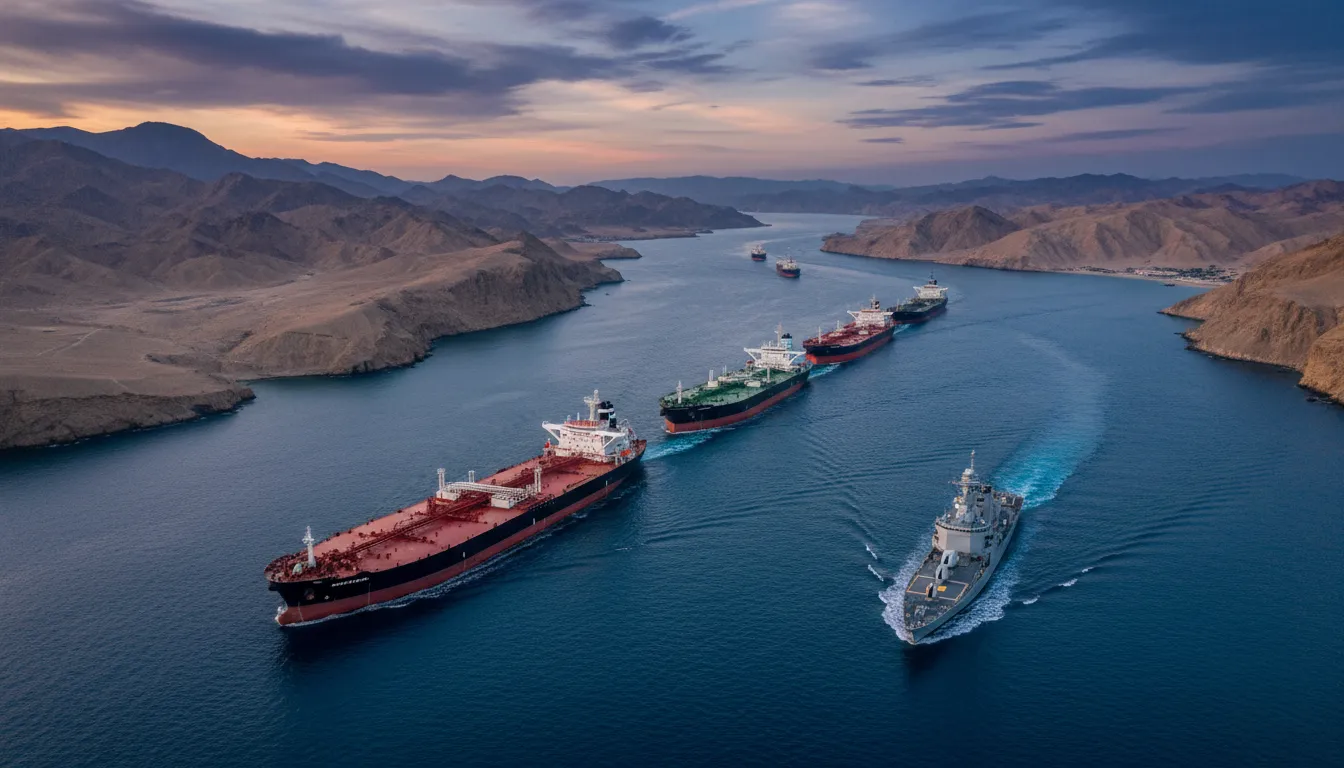
When an Indian tanker carrying liquefied petroleum gas (LPG) made its way through the Strait of Hormuz recently under military escort, the passage became the subject of breathless live television coverage across the subcontinent. The vessel's slow, tense transit through one of the world's most strategically vital waterways underscored a new and deeply unsettling reality: routine commercial shipping through the Strait has become anything but routine. Traffic at the chokepoint has been severely disrupted, and the question markets are now grappling with is not whether the disruption matters — it clearly does — but how long it will last and which commodities will suffer most.
Why the Strait of Hormuz Is Irreplaceable
The Strait of Hormuz is a narrow passage of water connecting the Persian Gulf to the Gulf of Oman, at its most constricted point measuring roughly 33 kilometres across. Despite its modest dimensions, it carries an outsized share of global energy trade. Estimates consistently place between 20 and 21 million barrels of crude oil and refined petroleum products through the strait every single day — roughly one-fifth of all oil consumed on the planet. There is simply no equivalent bypass. The only alternative pipeline route of significance is the Petroline (the East-West Pipeline) across Saudi Arabia to the Red Sea port of Yanbu, but its capacity is limited to around 5 million barrels per day, a fraction of what the strait handles.
Unlike the Suez Canal or the Bab-el-Mandeb Strait, where disruptions have historically prompted rerouting around the Cape of Good Hope at significant cost and delay, a genuine sustained blockade of the Strait of Hormuz has no viable workaround for the majority of Persian Gulf producers. Kuwait, Qatar, Bahrain, and the UAE have no other meaningful export route. Even Saudi Arabia and Iraq, which have some pipeline alternatives, would face severe export constraints if the strait were closed for any extended period.
LPG: The Commodity Drawing the Most Immediate Attention
The Indian tanker's passage captured public attention partly because LPG is a commodity with an intensely human dimension. In India, as across much of South Asia and East Africa, LPG is the primary cooking fuel for hundreds of millions of households. It is not an industrial input with easy substitutes — it heats food in kitchens. Disruptions to LPG supply translate quickly into visible hardship, making them politically sensitive in a way that, say, a rise in petrochemical feedstock prices is not.
The Persian Gulf accounts for a substantial portion of global LPG exports. Saudi Aramco's contract prices for LPG serve as benchmark references for much of Asia's import market. Qatar and the UAE are also significant LPG exporters. With Hormuz disrupted, buyers are scrambling for alternative suppliers — the US Gulf Coast, West Africa, and Australia — but these sources come with longer voyage times and higher freight costs, which feed directly into consumer prices.
"The Strait of Hormuz is not just an oil chokepoint. It is a gas chokepoint, an LPG chokepoint, a petrochemicals chokepoint. Every commodity that comes out of the Persian Gulf is affected simultaneously." — Senior Energy Analyst, IEA
LNG: Qatar's Export Lifeline Under Threat
Perhaps the commodity most exposed to a prolonged Hormuz disruption is liquefied natural gas. Qatar is the world's largest or second-largest LNG exporter depending on the year, responsible for roughly 20 to 22 percent of global LNG trade. Every single LNG cargo that leaves Qatar's Ras Laffan export terminal must transit the Strait of Hormuz. There is no pipeline alternative, no Cape route workaround, and no way to meaningfully replace Qatari volumes in the near term.
European buyers, who sharply increased their dependence on Qatari LNG after the reductions in Russian pipeline gas flows beginning in 2022, are particularly exposed. Asian buyers including Japan, South Korea, China, and India collectively take the majority of Qatari LNG under long-term contracts. Any sustained disruption forces those buyers to compete aggressively for spot cargoes from other suppliers, driving global LNG spot prices sharply higher and straining the spot markets that smaller or less creditworthy buyers rely upon.
Crude Oil and Refined Products
The crude oil market remains the headline story. Saudi Arabia, Iraq, Kuwait, the UAE, and Iran collectively export the bulk of their crude through the strait. Saudi Arabia's ability to sustain its position as the world's swing producer depends entirely on open access to the waterway. Iraq's federal budget, built around oil export revenues, is similarly hostage to passage through Hormuz. A prolonged closure would trigger an immediate supply shock of a scale that the world's strategic petroleum reserves — collectively around 1.4 billion barrels held by IEA member countries — could buffer only temporarily.
Refined products are equally at risk. Several large Gulf refineries, including Saudi Aramco's Jazan complex and Abu Dhabi's Ruwais facility, export significant volumes of diesel, jet fuel, and naphtha that transit the strait. Naphtha is particularly important as a petrochemical feedstock across Asia, and any shortage ripples quickly through plastics and synthetic materials supply chains.
Market Impact
Energy markets have responded with sharp moves across multiple benchmarks:
- Brent Crude: Prices have surged on the supply disruption fears, with the geopolitical risk premium widening substantially. Volatility has spiked as traders attempt to price in scenarios ranging from temporary disruption to prolonged closure.
- WTI: US domestic crude has tracked Brent higher, though the spread has narrowed as American producers and exporters are perceived as beneficiaries of any sustained reduction in Gulf supply.
- LNG Spot Prices: Asian LNG spot benchmarks have surged as buyers seek to secure cargoes away from the disrupted region. European TTF gas prices have also risen in sympathy.
- LPG: Saudi Aramco's Contract Price benchmarks have moved sharply, with freight premiums for alternative-source cargoes amplifying the total cost impact for Asian importers.
- Petrochemicals: Naphtha and ethylene markets are under pressure as Gulf feedstock availability tightens, adding cost inflation pressures to downstream manufacturing.
Military Escorts and the Operational Reality
The requirement for military escorts introduces friction that goes beyond simple disruption. It introduces costs, delays, and coordination requirements that are difficult to sustain at scale. Commercial vessels are not designed to operate in convoy formation under naval protection, and the navies capable of providing meaningful escort — the US Fifth Fleet, the Indian Navy, elements of European naval forces — have finite resources. Prioritising which cargoes receive protection and which must wait creates its own market distortions, favouring large, strategically connected national oil companies and leaving smaller or independent buyers disadvantaged.
Insurance underwriters have responded by sharply raising war-risk premiums for the region, adding further costs to every cargo that transits the area. Some tanker operators have suspended sailings entirely pending clearer guidance on the security situation, tightening the effective supply of available vessels for the route.
What to Watch
The duration and intensity of the disruption will determine its ultimate market impact. Traders and market participants should monitor several key indicators in the days and weeks ahead. First, the pace at which military escort capacity can be scaled up or maintained will signal how quickly something approaching normalcy in transit volumes might return. Second, any diplomatic developments affecting the underlying cause of the disruption will be critical — markets will respond strongly to credible signs of de-escalation or, conversely, to any indication of escalation toward outright closure. Third, the rate at which alternative supply sources — US LNG exports, West African LPG, Atlantic Basin crude — can be mobilised will determine how much of the gap can be bridged in the near term. Finally, any decisions by IEA member countries to coordinate strategic petroleum reserve releases will be closely watched as an indicator of how seriously governments assess the supply risk. In the interim, the world is being reminded, vividly, of just how much of the global energy system flows through a strip of water 33 kilometres wide.