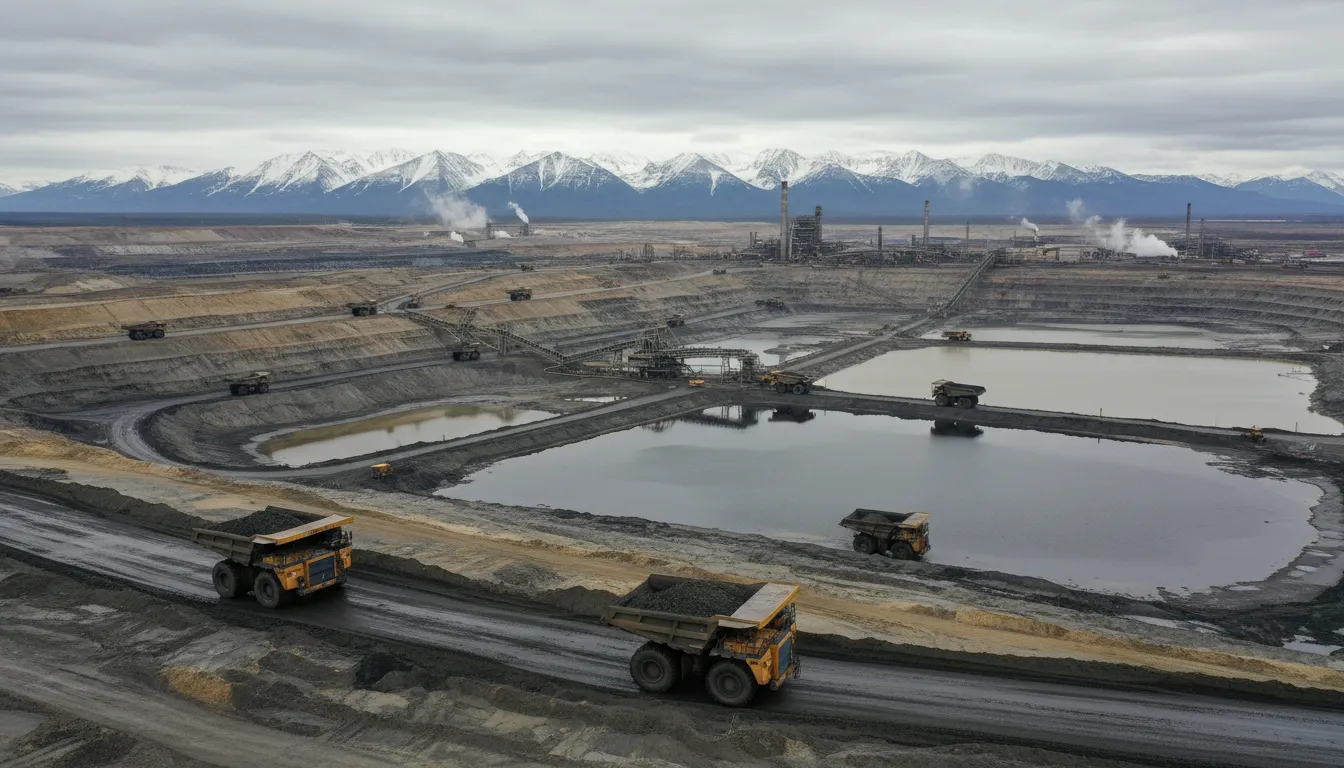
Brent crude has surged past $108 per barrel and WTI cleared $111 in the wake of renewed U.S.-Iran tensions, delivering a windfall to energy-producing regions around the world. Yet for Alberta — Canada's oil heartland and the province most directly exposed to crude price swings — even a sustained rally to triple digits may not be enough to close a multibillion-dollar budget gap. The math, as Alberta's own finance minister has acknowledged, simply does not work in the province's favor at current price levels.
Alberta's Finance Minister Delivers a Blunt Assessment
Alberta Finance Minister Nate Horner did not sugarcoat his outlook when asked whether the recent oil price surge could rescue the province's battered fiscal position. Speaking publicly this week, Horner addressed the question directly and concisely.
"Is it enough to take us out of a deficit position? Highly unlikely." — Nate Horner, Alberta Finance Minister
The candor reflects a structural reality that has dogged Alberta's finances for years: the province's spending commitments, royalty framework, and budget assumptions make it exceptionally difficult to convert high oil prices into balanced books. The 2025–26 budget was constructed on a WTI forecast of $60.50 per barrel. At that baseline, the projected deficit stood at $9.4 billion — a figure that shocked many observers given how high crude prices remained relative to the lows of prior downturns.
The province's own modeling suggests that WTI would need to average between $74 and $77 per barrel for the entire fiscal year to eliminate the deficit. With the first half of the year anchored near the $60–$67 range before this month's conflict-driven spike, the annual average has been pulled well below what would be needed to make the arithmetic work.
The Revenue Sensitivity Problem
Alberta's royalty structure does generate substantial revenue from oil price increases, and the sensitivity is not trivial. Each one-dollar move in the WTI price is estimated to produce approximately $680 million in additional annual revenue for the province. At first glance, a $40–$50 per barrel increase above the budget baseline should, in theory, generate tens of billions in additional funds.
In practice, however, several factors limit the fiscal translation. First, royalty calculations are based on annual average prices, not spot prices at any given moment. A spike that lasts weeks or even a few months contributes far less to the annual average than a sustained high-price environment. Second, Alberta's royalty regime includes tiered structures and cost-recovery provisions that reduce the province's effective take during periods when producers are still recovering large capital investments — a dynamic that applies to many of the major oil sands projects currently operating in the province.
Third, and perhaps most significantly, the province's spending commitments have grown substantially. Healthcare costs, infrastructure obligations, education funding, and transfers to municipalities have all increased faster than projected over the past several budget cycles, meaning the breakeven price required to balance the books has risen even as oil prices improved.
How Alberta Compares to Other Oil Producers
Alberta's predicament stands in sharp contrast to the fiscal positions of several major sovereign oil producers, and even to some of its direct competitors for capital and market share. The comparison is instructive:
- Saudi Arabia requires Brent crude in the range of $90–$100 per barrel or higher to balance its national budget, a figure driven by the kingdom's vast social spending commitments and the cost of economic diversification initiatives under Vision 2030. At current prices above $108, Riyadh is generating surplus revenue but operating close to its fiscal edge.
- United Arab Emirates is in a considerably stronger position, with a fiscal breakeven estimated near $66 per barrel. At current prices, the UAE is almost certain to record a meaningful budget surplus, providing headroom for sovereign wealth fund contributions and continued infrastructure investment.
- Qatar enjoys one of the most favorable fiscal outlooks in the Gulf, with its breakeven price projected to fall to approximately $50 per barrel by 2027 as LNG expansion projects reach full production. Qatar's gas-weighted revenue base makes it comparatively insulated from crude price volatility.
- Bahrain sits at the opposite end of the spectrum. With a fiscal breakeven estimated between $124.9 and $125.7 per barrel — well above current prices even after the recent surge — Bahrain faces continued and deepening deficits regardless of the current rally.
- Alberta falls somewhere in the middle of this range, but unlike sovereign producers with direct ownership of oil assets, the province's revenue comes through royalties and corporate taxes on private operators, creating additional structural friction in the revenue transmission mechanism.
Energy Markets and the Broader Windfall
While Alberta's fiscal math remains challenged, the broader energy sector has been a clear beneficiary of the price surge. The S&P/TSX Capped Energy Index has gained nearly 40% year-to-date, vastly outperforming broader equity markets. The S&P 500 has declined approximately 4.5% over the same period, making energy stocks one of the standout asset classes of 2026.
The surge in Brent to $108.80 and WTI to $111.70 was triggered most directly by President Trump's announcement that the United States would strike Iran "extremely hard" over the next two to three weeks in response to the escalating conflict. The Persian Gulf threat premium has been substantial, with traders pricing in potential disruptions to Strait of Hormuz transit and Iranian production. Average U.S. gasoline prices have crossed $4.00 per gallon for the first time since the summer of 2022, adding an inflationary dimension to what is already a politically charged price environment.
What Would It Actually Take?
For Alberta to exit its deficit position in the current fiscal year, several conditions would need to hold simultaneously. WTI would need to remain consistently above $74–$77 for the remainder of the fiscal year — a level that is technically achievable at current spot prices but far from guaranteed over an annual average basis. Royalty revenues would need to materialize in line with the province's price sensitivity models, without being offset by producer cost-recovery provisions. And spending would need to hold at or below budgeted levels, a difficult ask in an environment where healthcare and infrastructure pressures are ongoing.
Even under an optimistic scenario in which crude prices remain elevated through the rest of 2026, analysts suggest the deficit would narrow substantially but not be eliminated entirely. The province may end the year with a deficit in the range of $3–$5 billion rather than the projected $9.4 billion — still a significant shortfall, and one that would add to an already growing provincial debt load.
"Alberta's challenge is not that oil prices are too low — it's that the province built a cost structure that requires prices to be consistently high, not just episodically high. A spike doesn't fix a structural problem." — Energy sector analyst, Bay Street investment firm
The Structural Lesson for Resource-Dependent Budgets
Alberta's situation is a case study in the hazards of structuring public finances around volatile commodity revenues. When prices are low, the deficit is acute. When prices spike, the windfall is real but often insufficient to close the gap accumulated during lean years — and frequently arrives too late in the fiscal year to shift the annual average meaningfully.
The province has discussed, and at various points implemented, mechanisms to smooth revenue volatility — including the Alberta Heritage Savings Trust Fund, established in 1976 to capture a share of oil royalties for future generations. But contributions to the fund have been sporadic over the past two decades, and the fund's current balance, while substantial, has not grown at a rate commensurate with the scale of oil revenues that have flowed through the provincial economy.
As the current rally runs its course — driven by geopolitical factors that could reverse as quickly as they emerged — Alberta's finance ministry faces the familiar challenge of projecting future revenues against a commodity backdrop that remains fundamentally unpredictable. For now, the message from Minister Horner is clear: $100 oil is welcome, but it is not the solution to Alberta's fiscal equation.